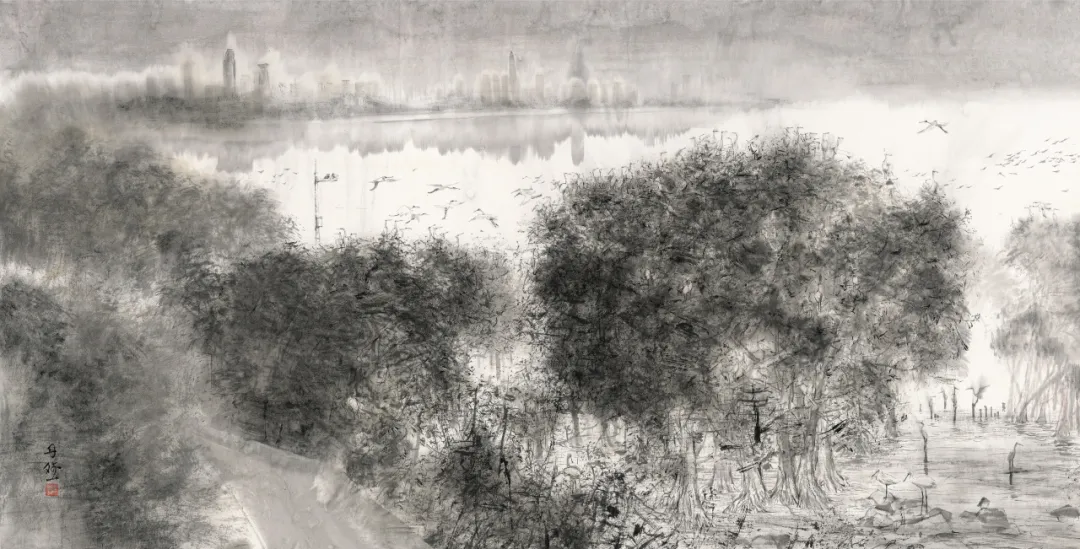
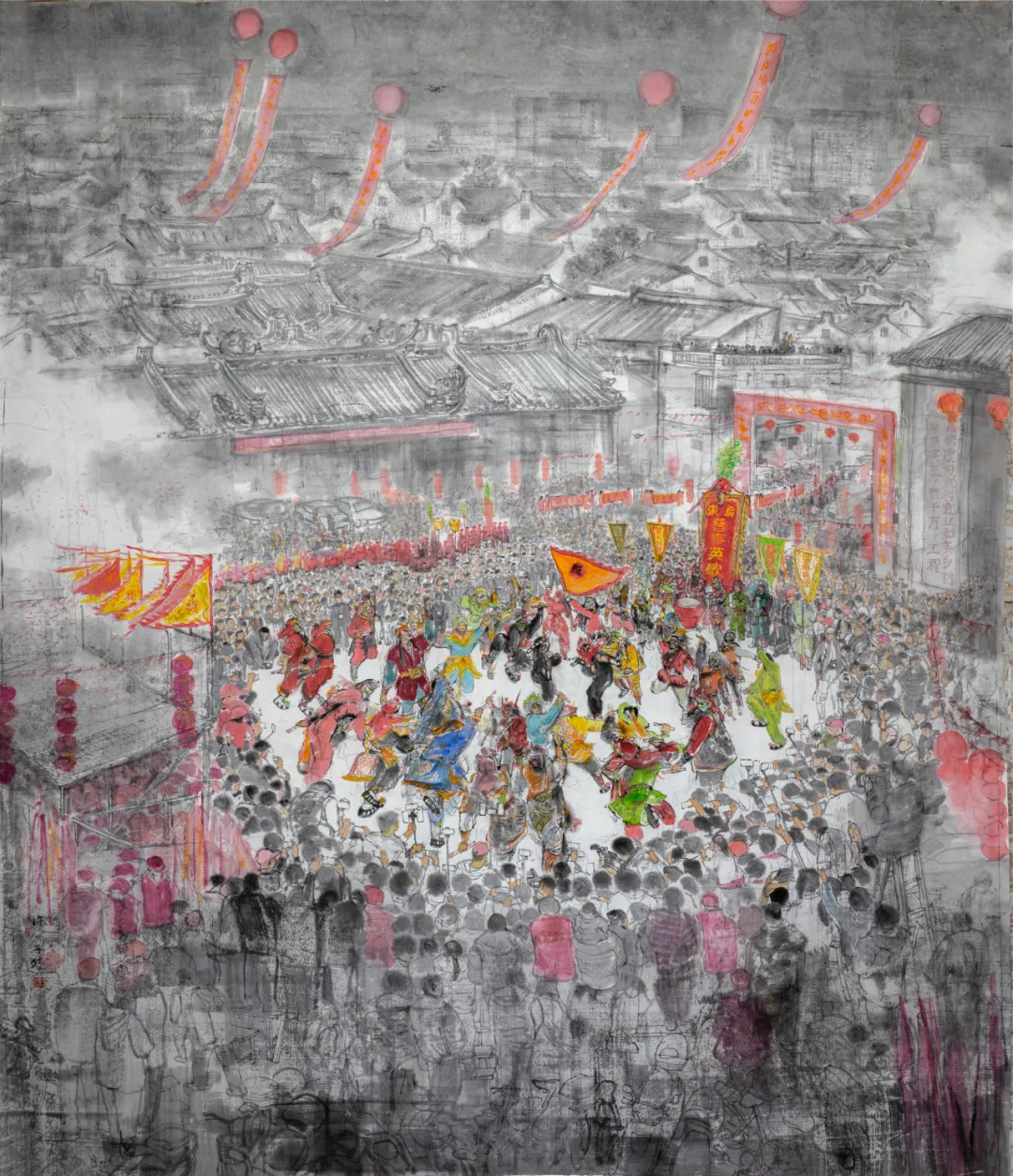
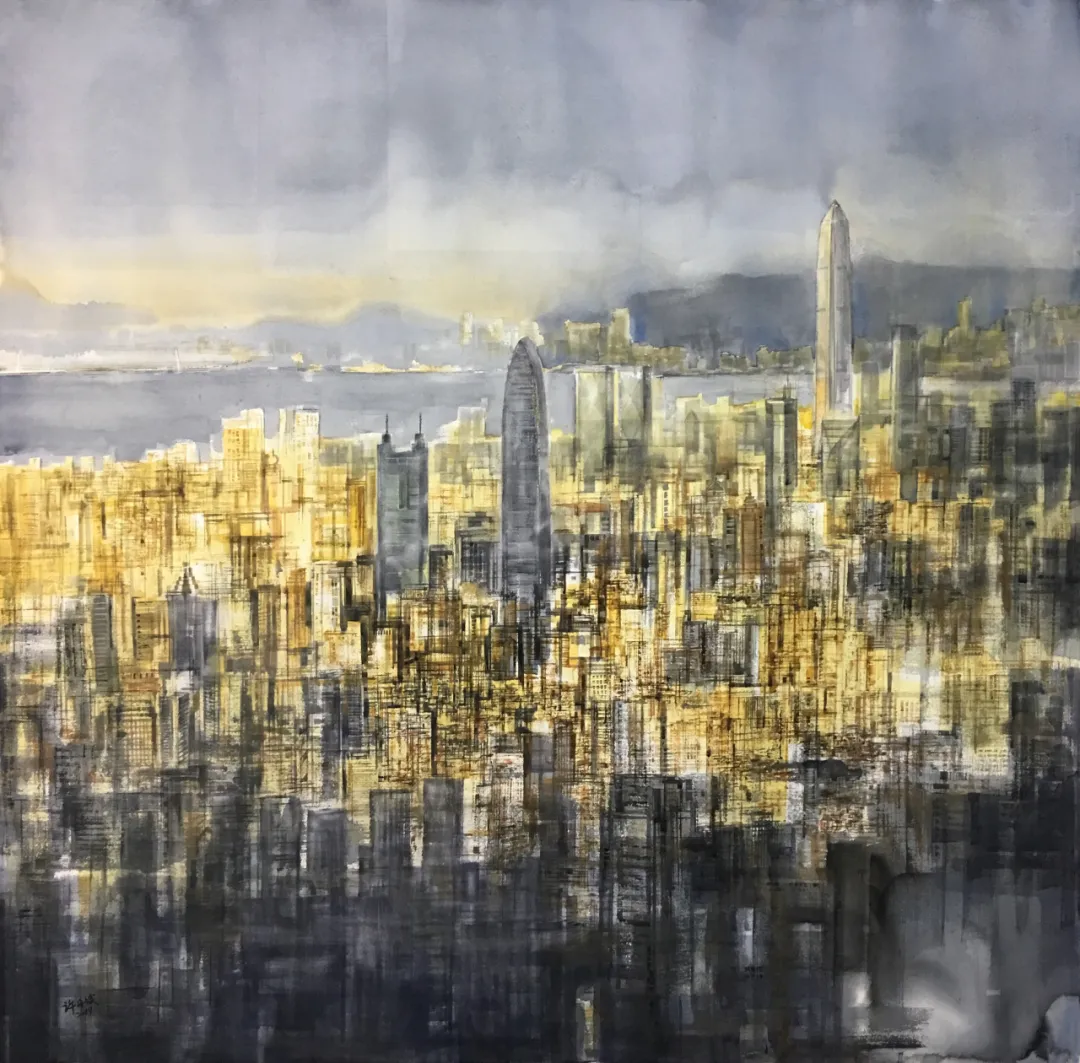
Urban ink painting is an inevitable reflection of how landscape and bird-and-flower painters contemplate contemporary life and their own presence within the canvas. It is a spiritual expression that unites the inner self with the desire-filled, vibrant city. However, artists’ creative orientations vary: some explore without using traditional brush and ink, fully abstracting or even leaning toward surrealism, while others do not hesitate to employ modern materials in an attempt to break new ground. But painter Xu Danbin adheres to cultural confidence, maintaining his personal brushwork style, integrating traditional landscape spatial techniques into contemporary urban scenery, and creating a distinctive spatiotemporal framework, achieving a transformation in ink visual expression. The lyrical poetry and grand, dreamlike songs within his works reflect his meticulous dedication, with each painting embodying his era-specific value judgments.
Over ten years ago, a group of painters in Shenzhen faced the same question when responding to the era's theme of urban ink painting: Could the traditional subjects of landscapes, flowers and birds, and even figures still be used? How could their forms be appropriately adapted to the 'urban' context? Although everyone was moving in the same direction, there were many unknowns that needed to be explored. Leading figure Dong Xiaoming chose 'lotus' as his subject, unfolding a faintly discernible concreteness within abstraction, allowing ink to bloom into rich layers of imagination through 'light ink seeking staining.' The poetry outweighs the pictorial scene, creating a sense of hazy beauty. Core figure Yang Xiaoyang has a broad perspective and observes the city with sensibility, using diverse subjects and combining color with ink. His works depict the flow of urban life, as if recording it with a literary mirror. Artist Zou Ming abandons the 'boudoir charm' of Jiangnan's small studios; when transitioning to grand narratives in large-scale works, his ink brushwork gains the power and variety of oil painting. Shenzhen's urban ink painting awakened a group of young and middle-aged artists who had been immersed in self-reflection and lost direction; they all began adjusting themselves and facing new dimensions. At that time, the young painter Xu Danbin did not hesitate to follow in the footsteps of the pioneers with his 'Growth Series' works.
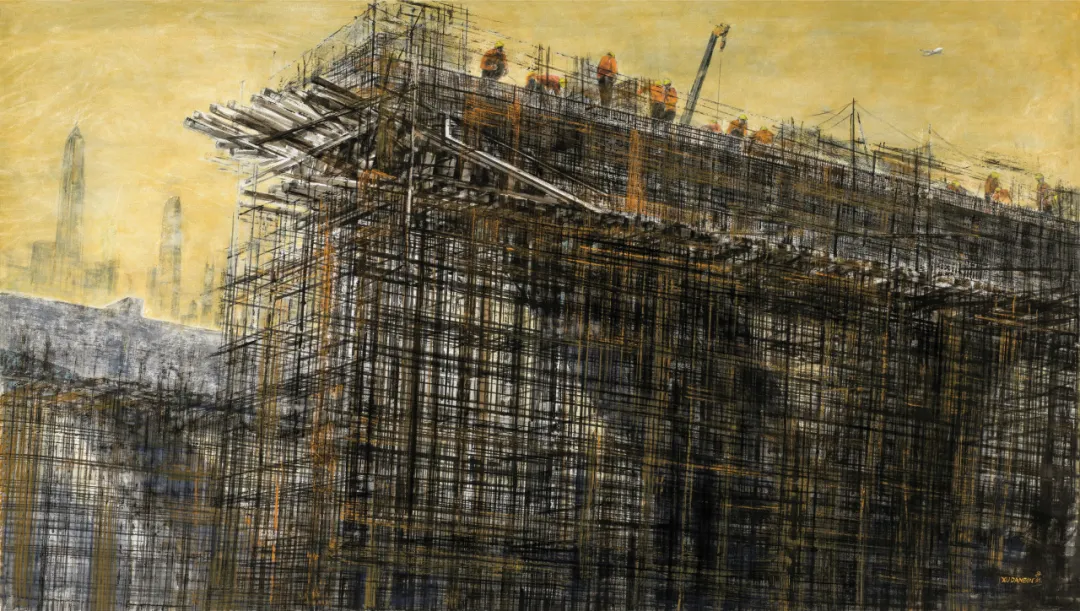
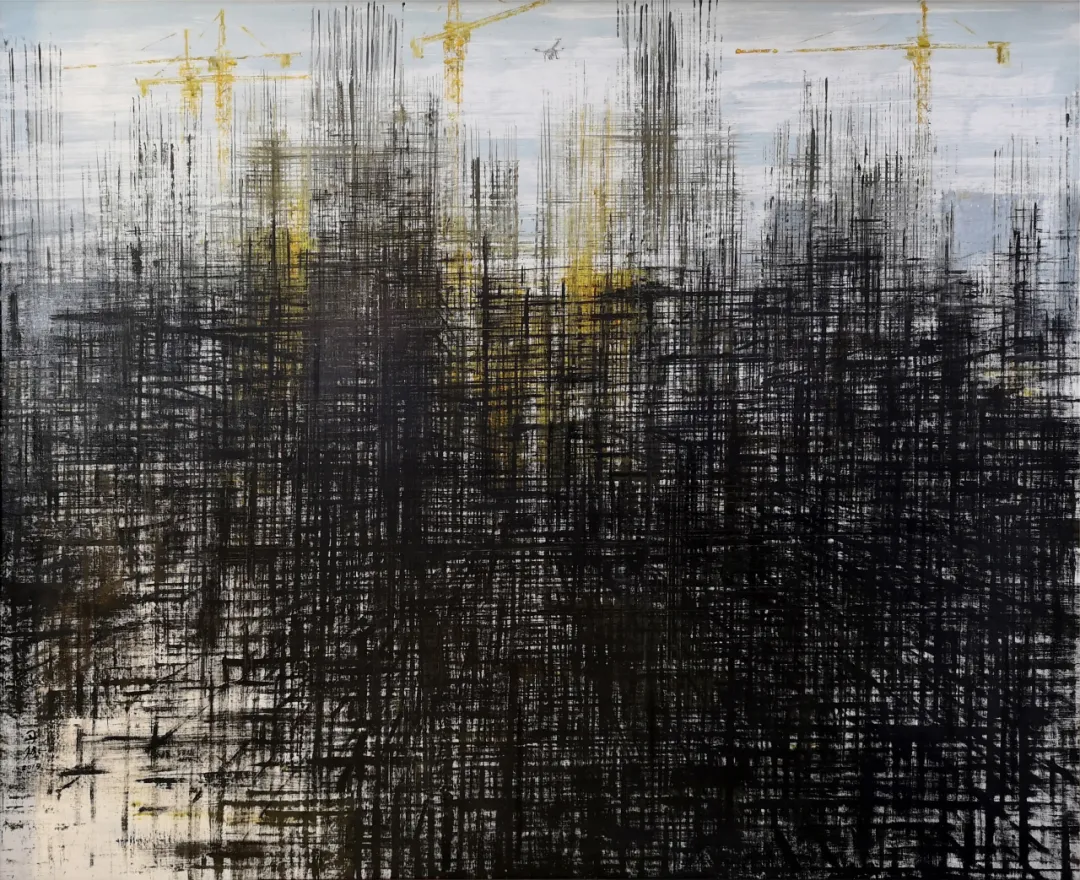
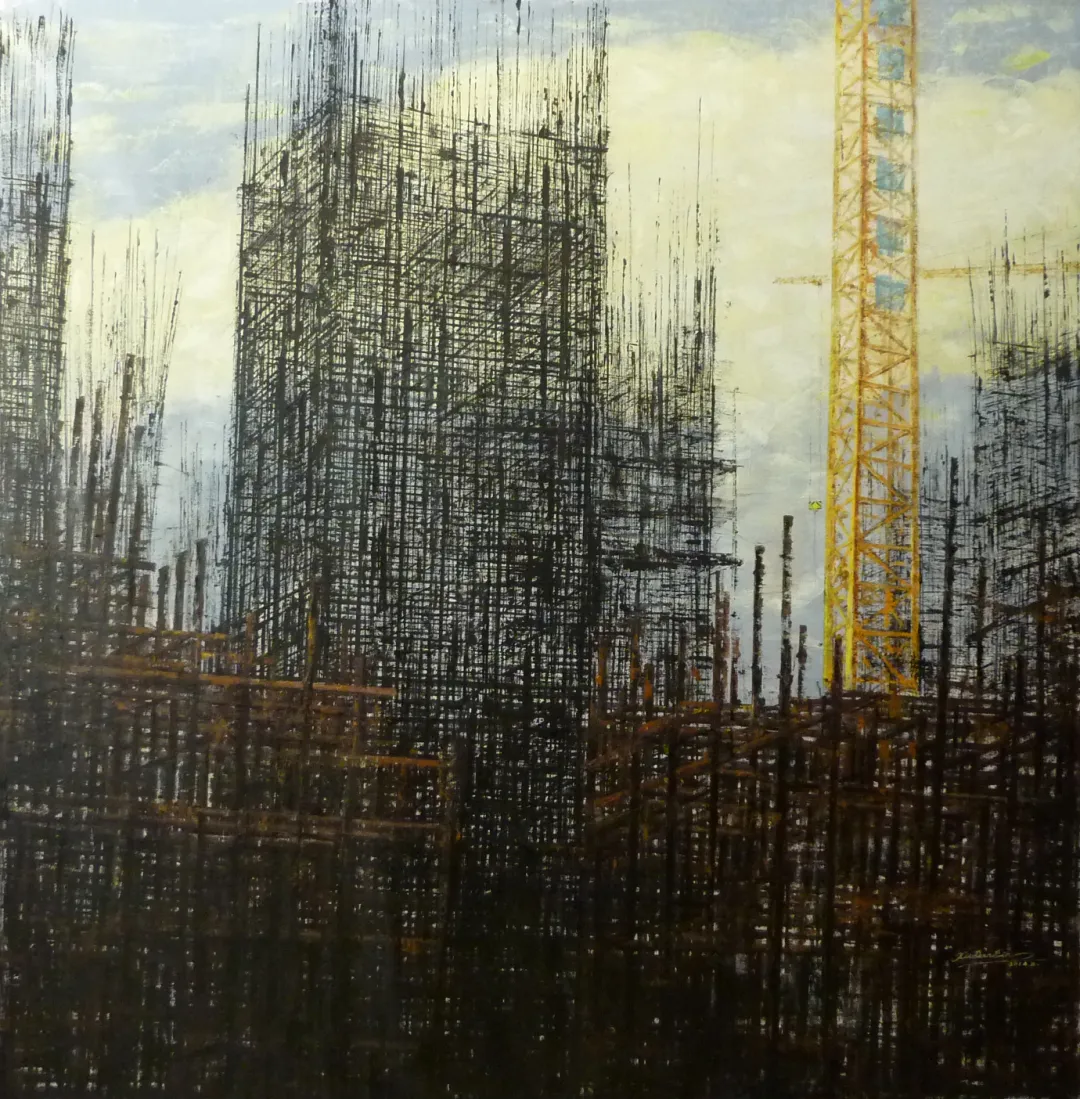
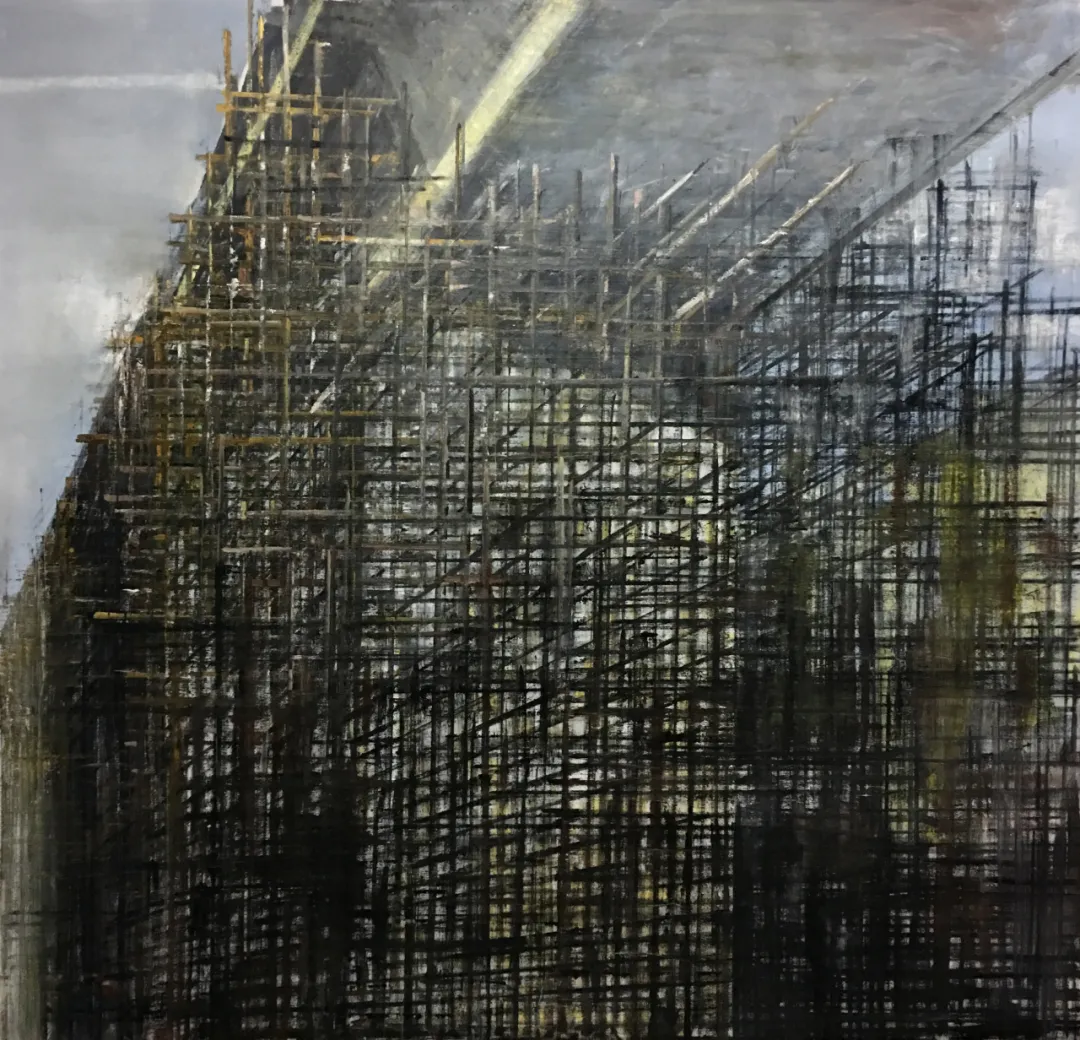
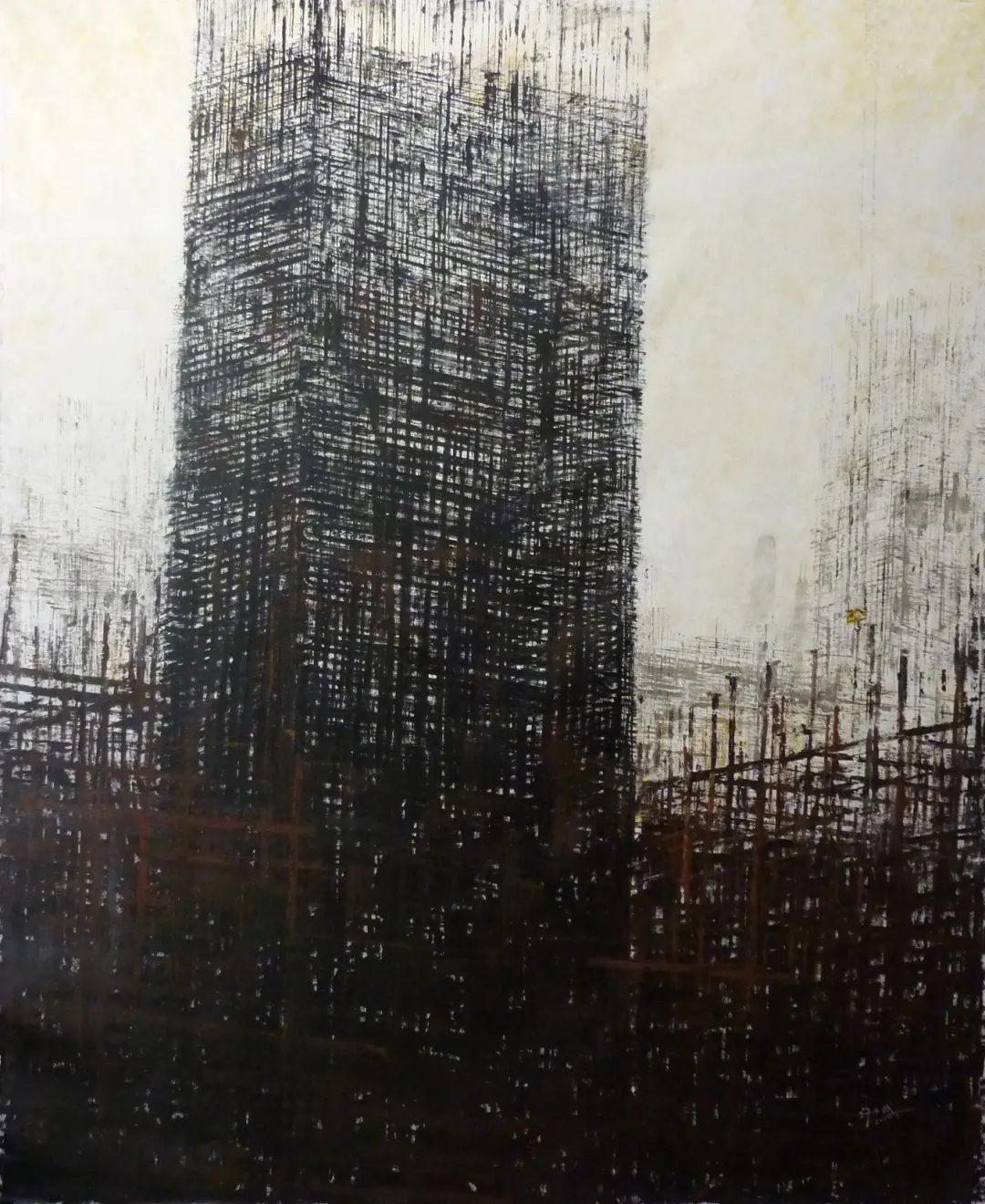
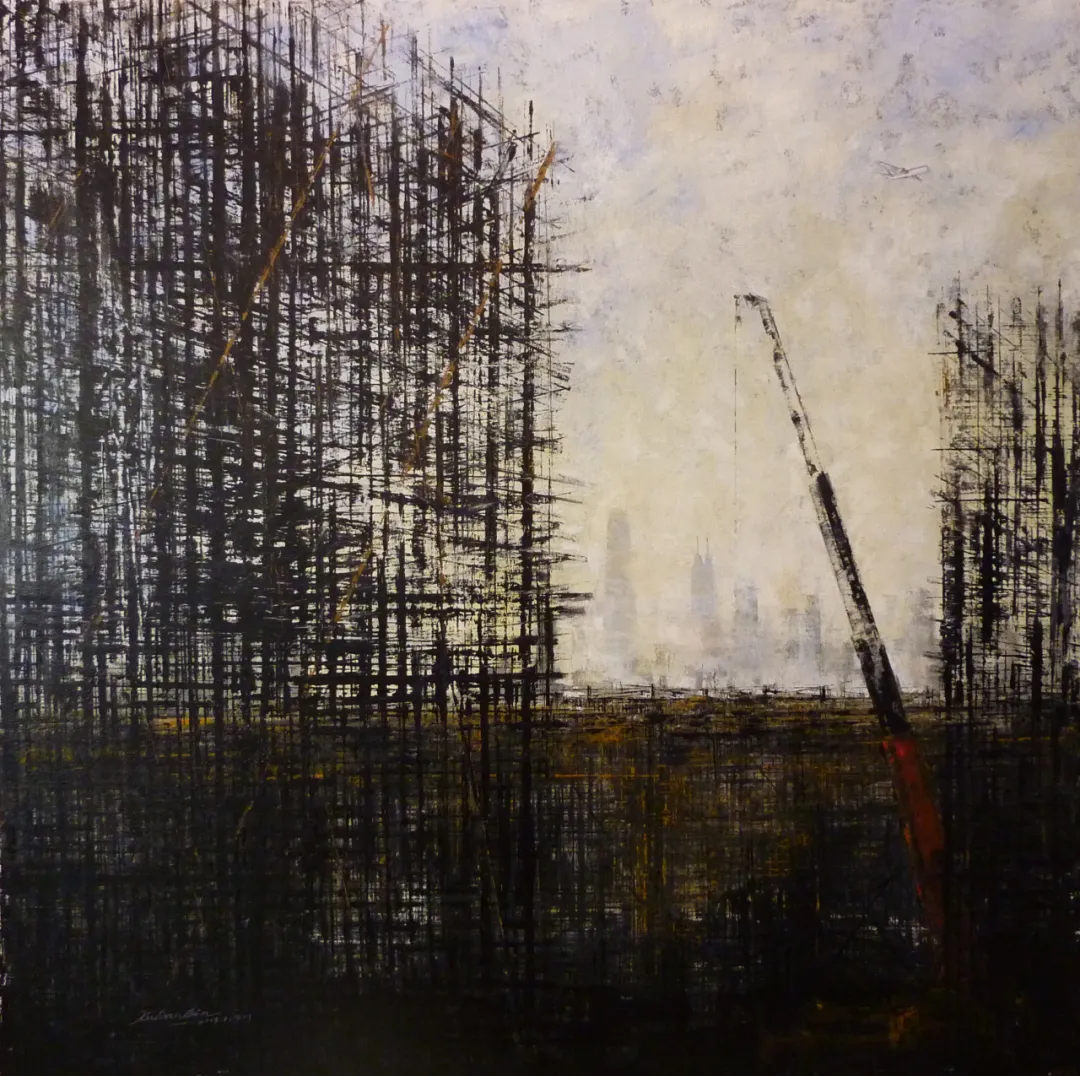
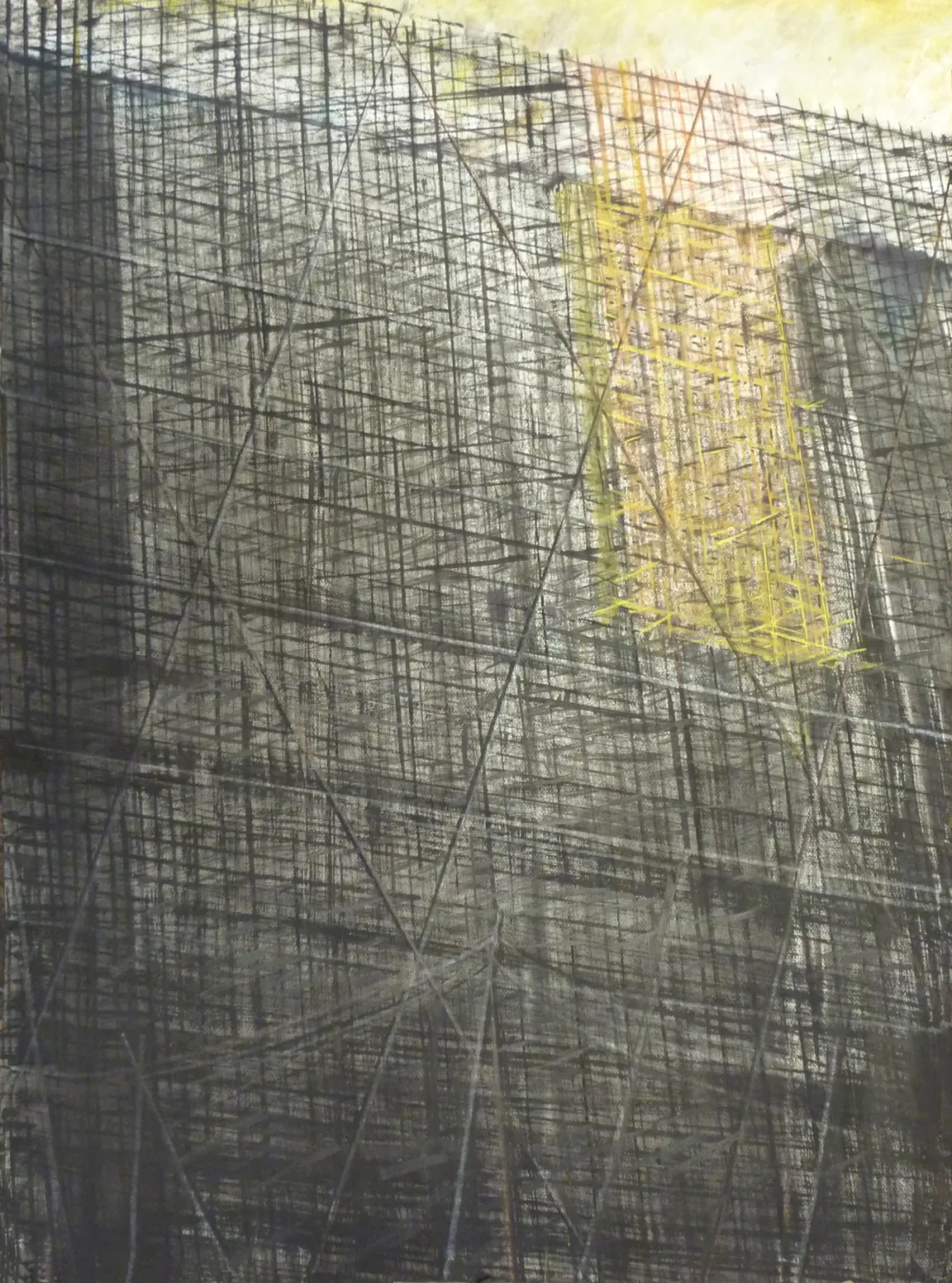
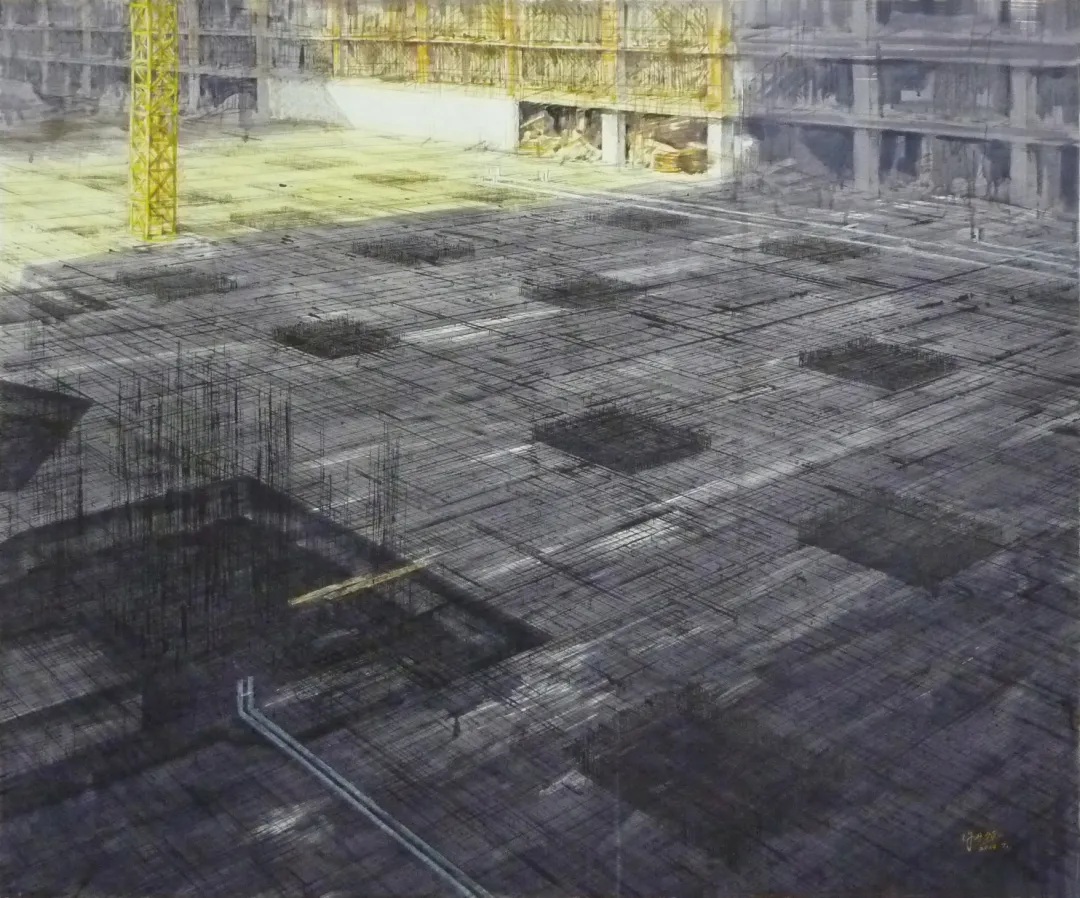
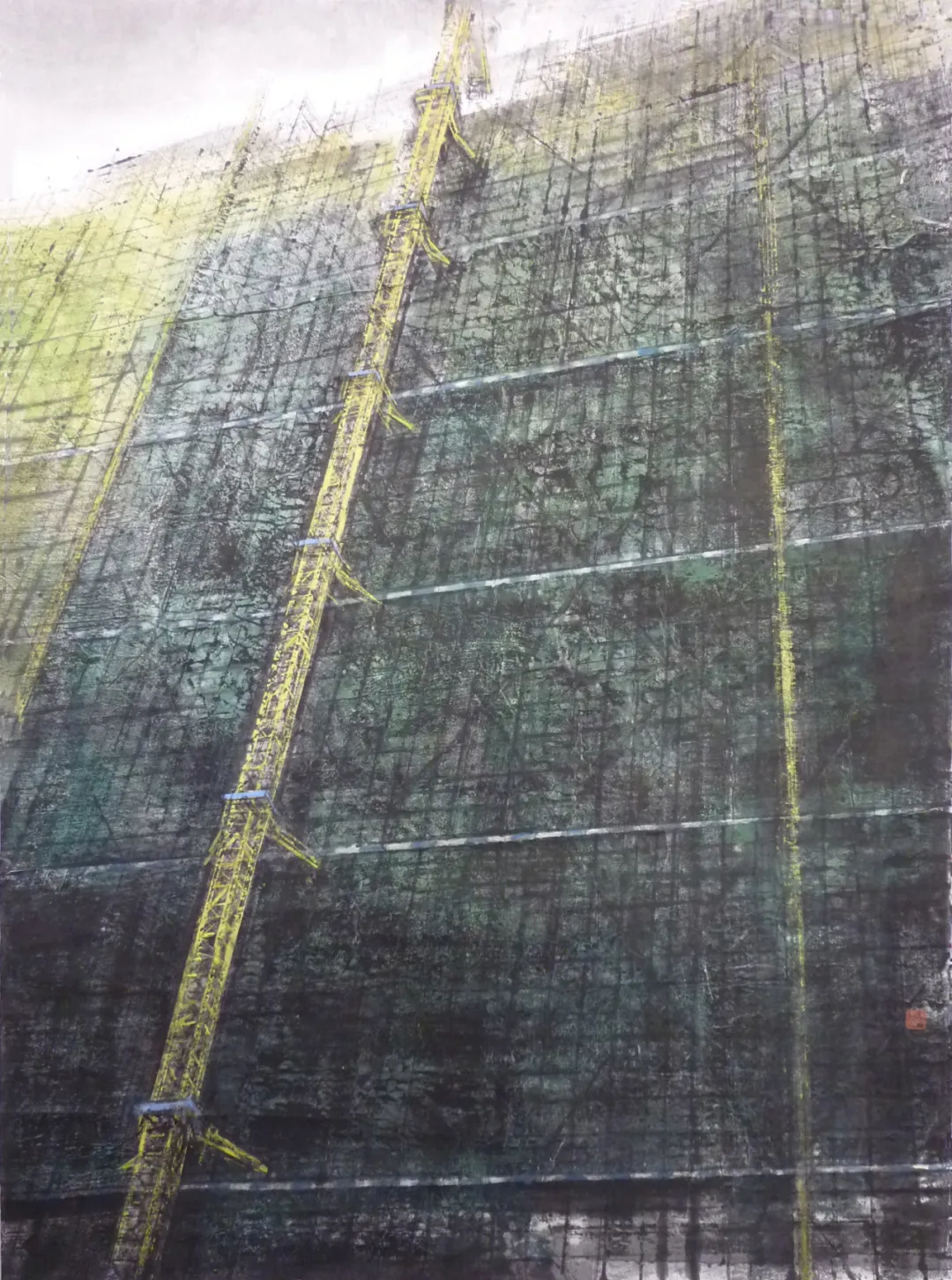
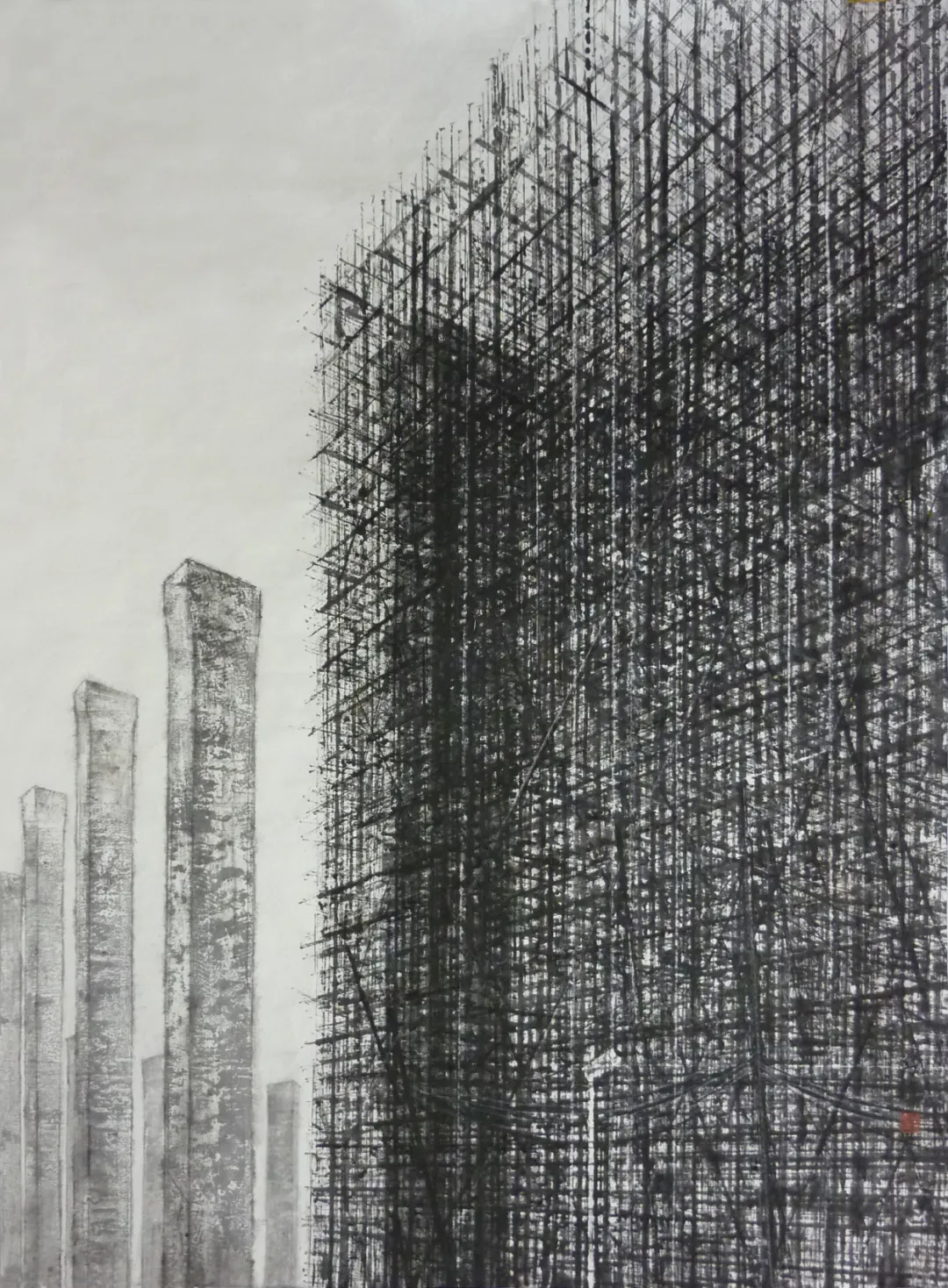
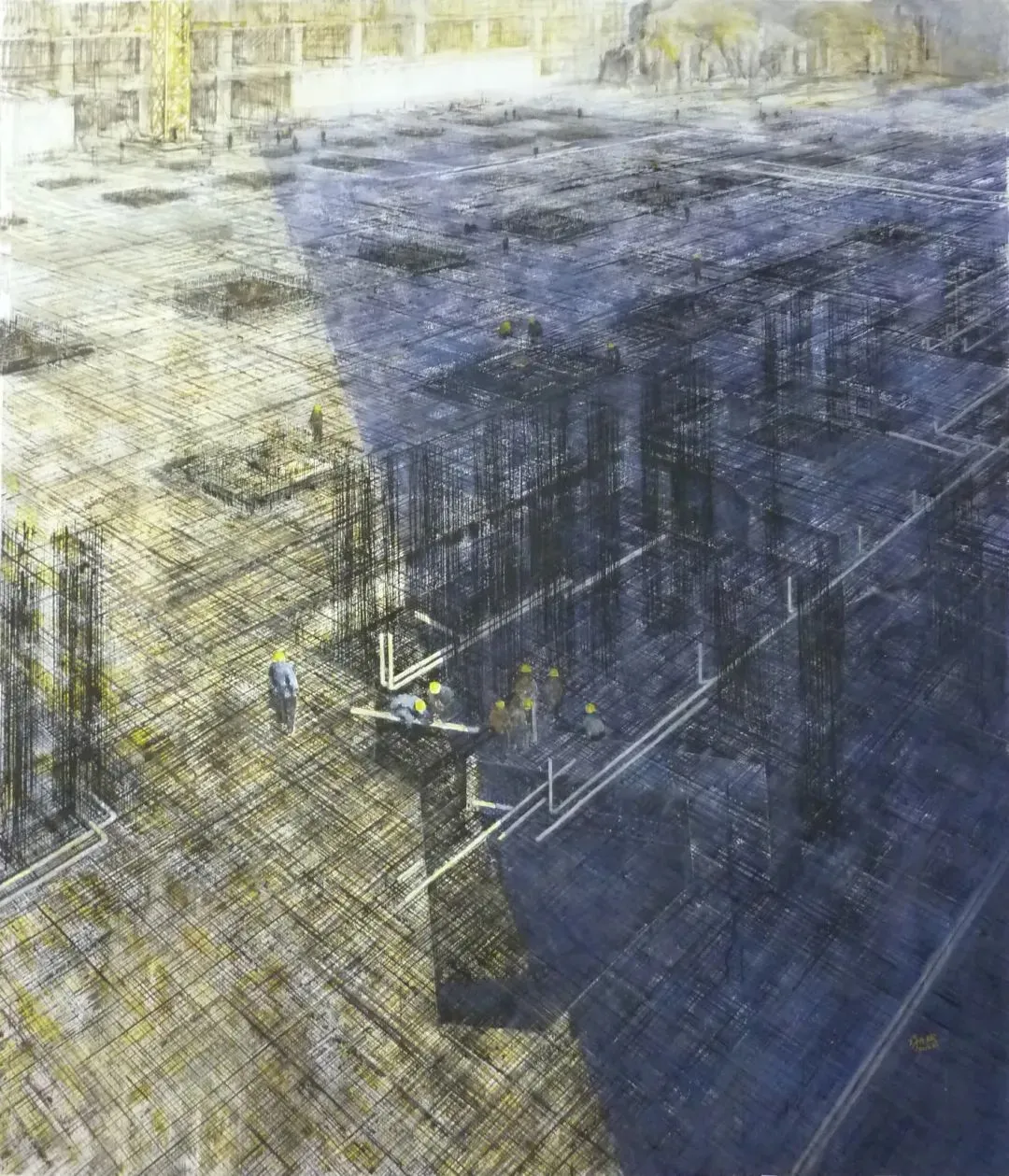
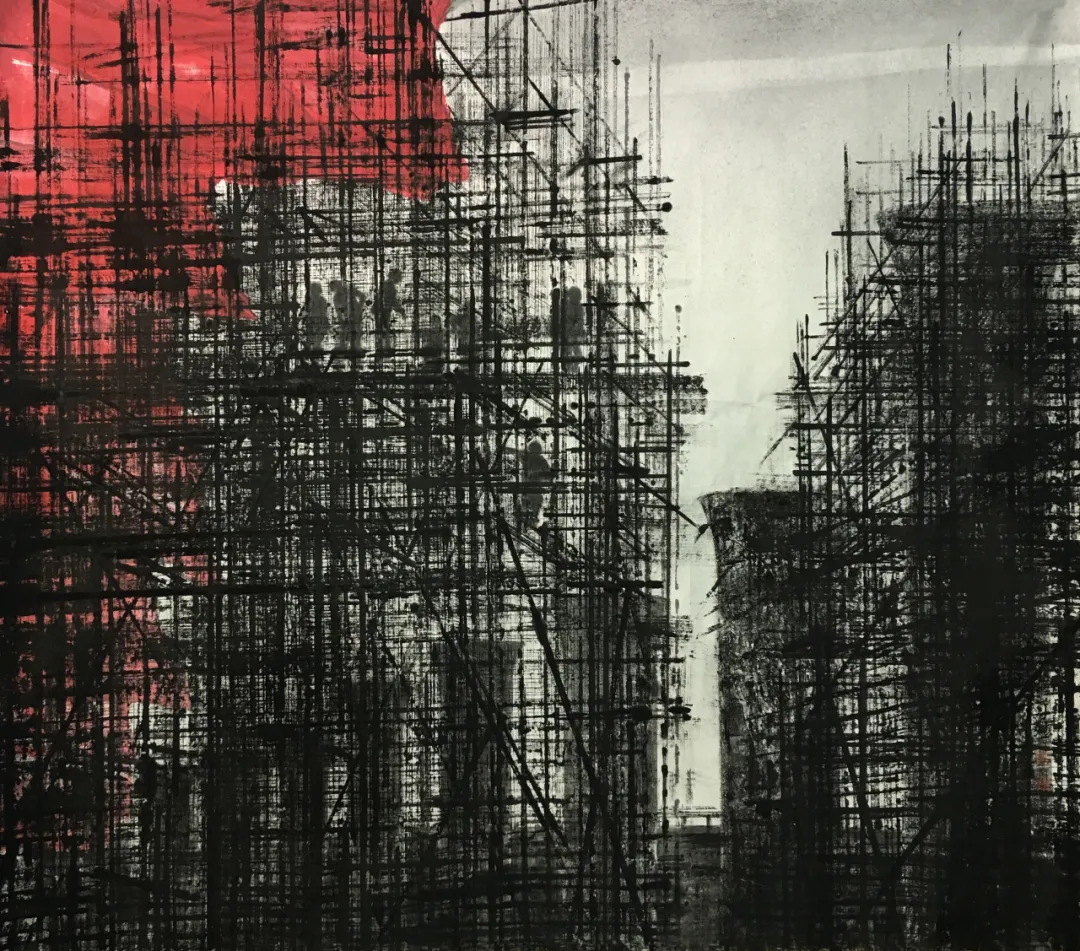
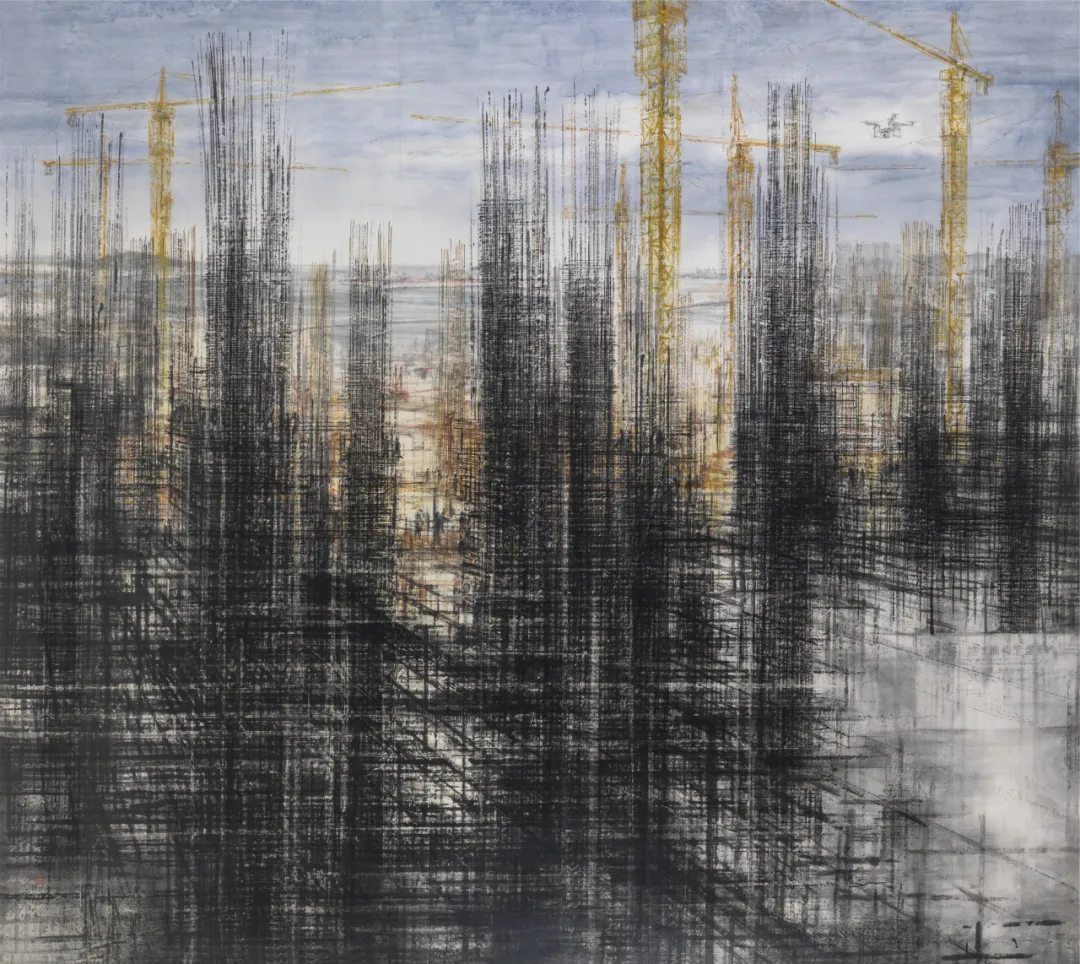
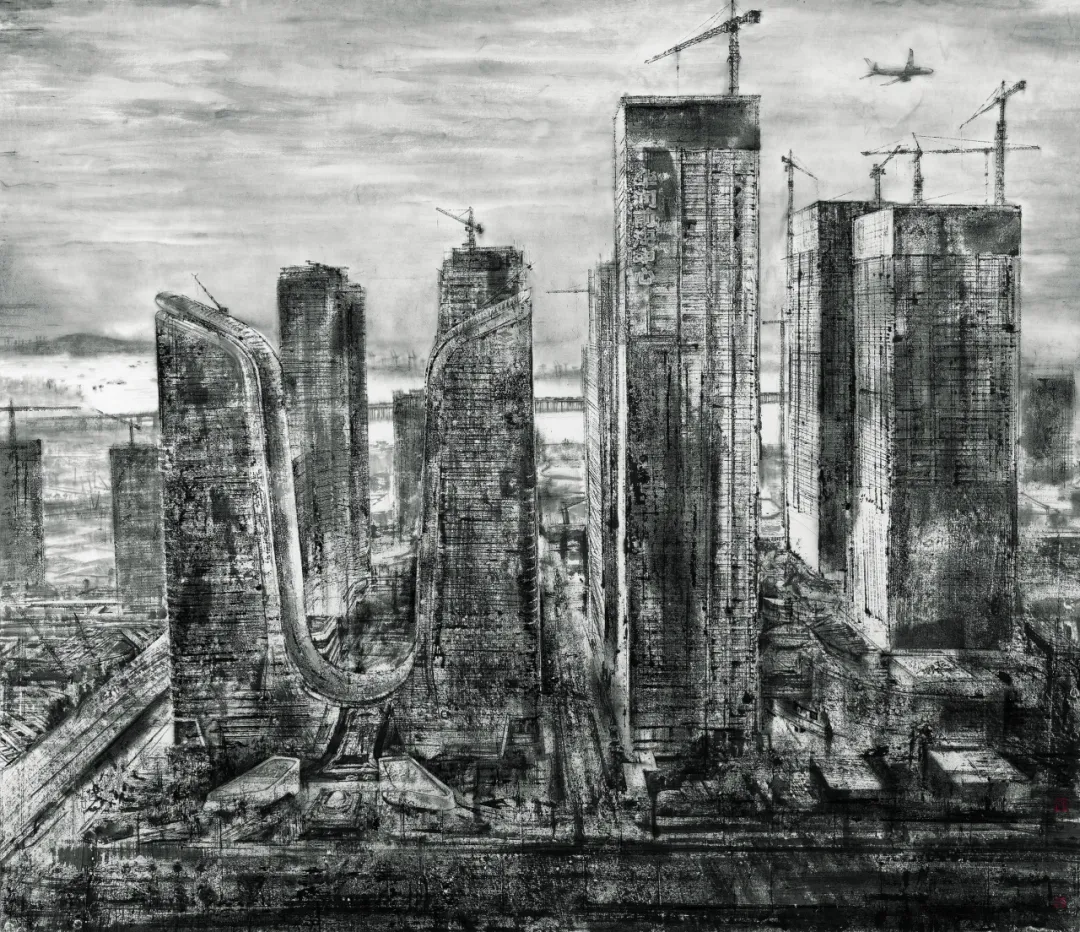
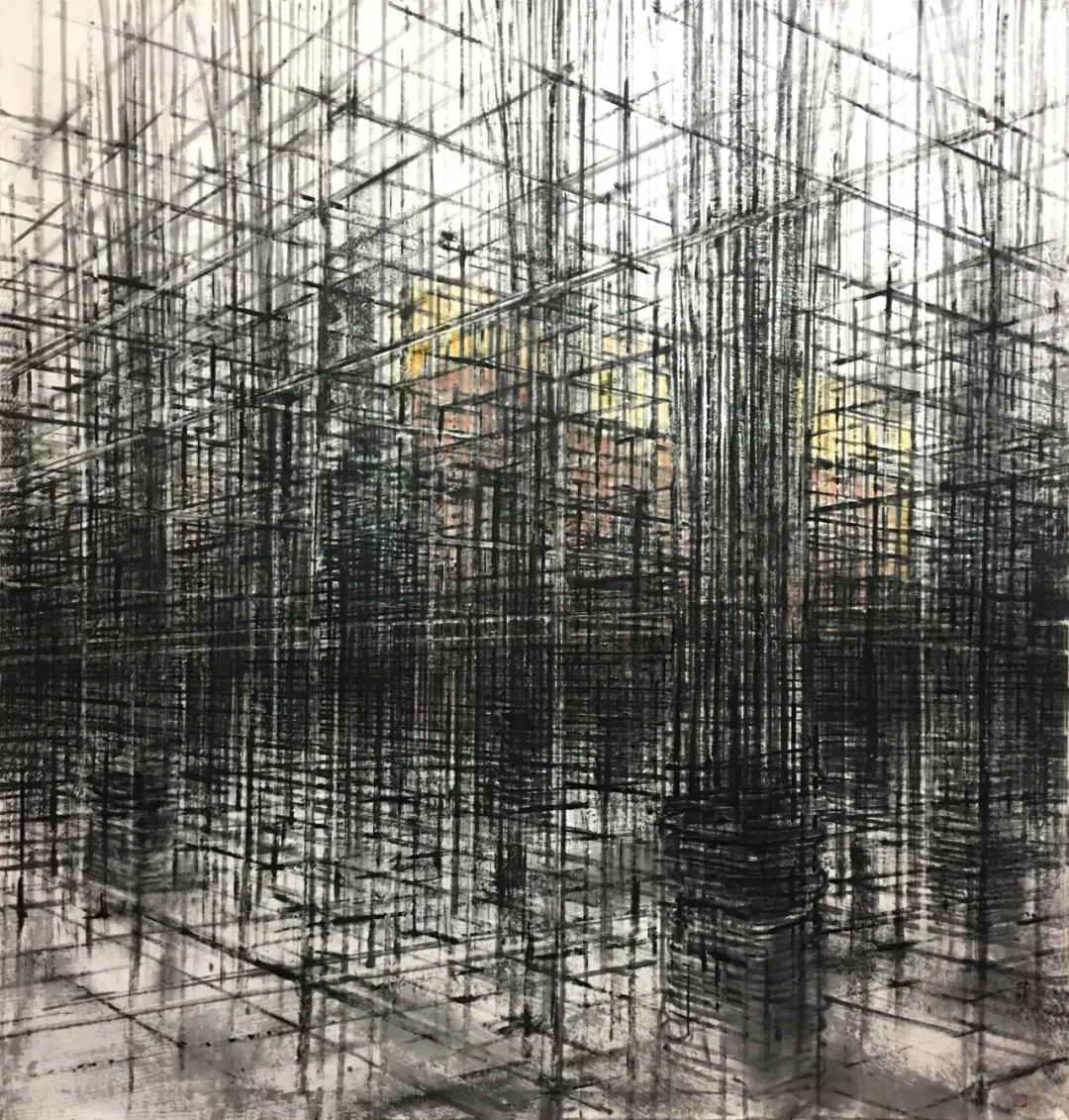
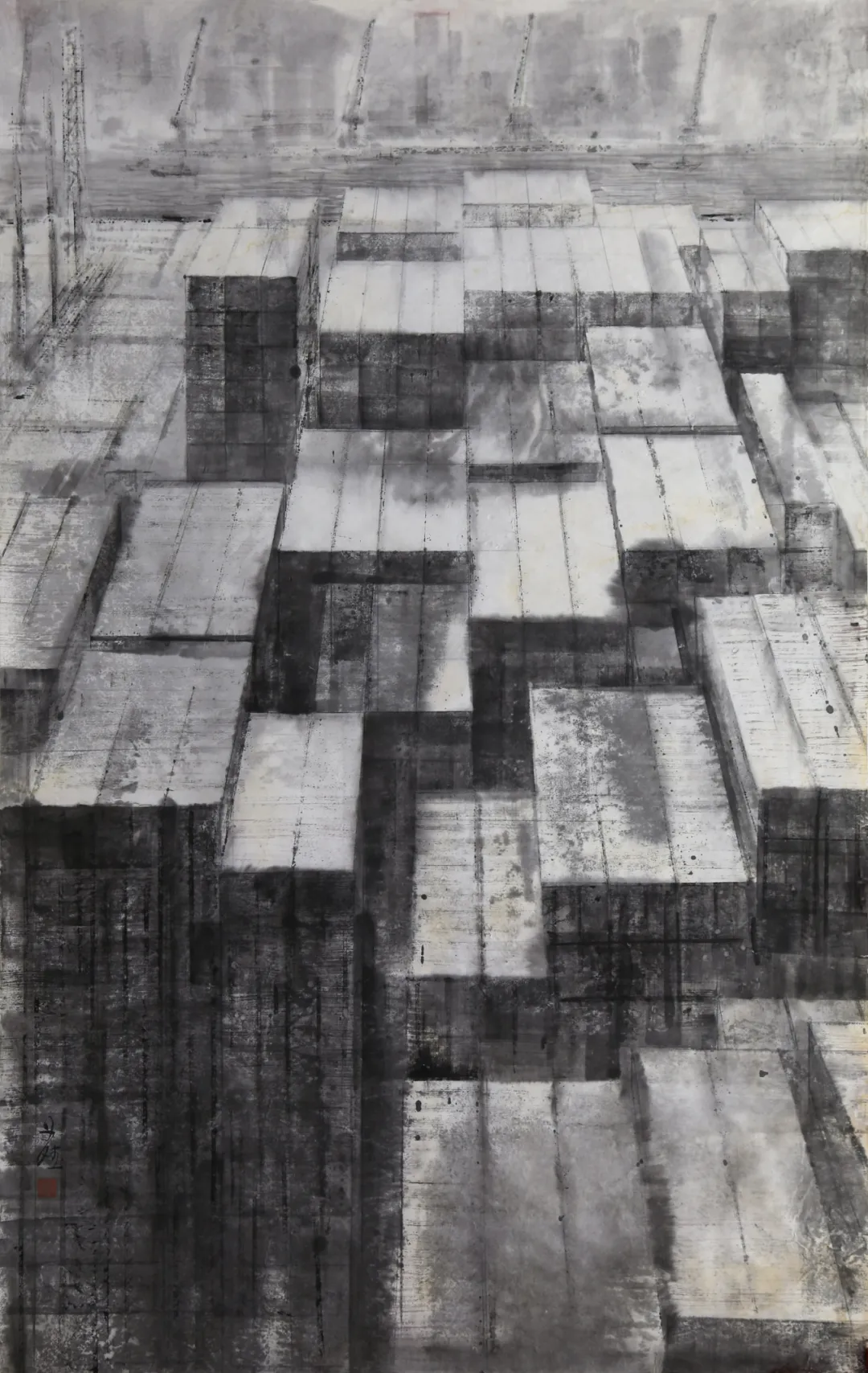
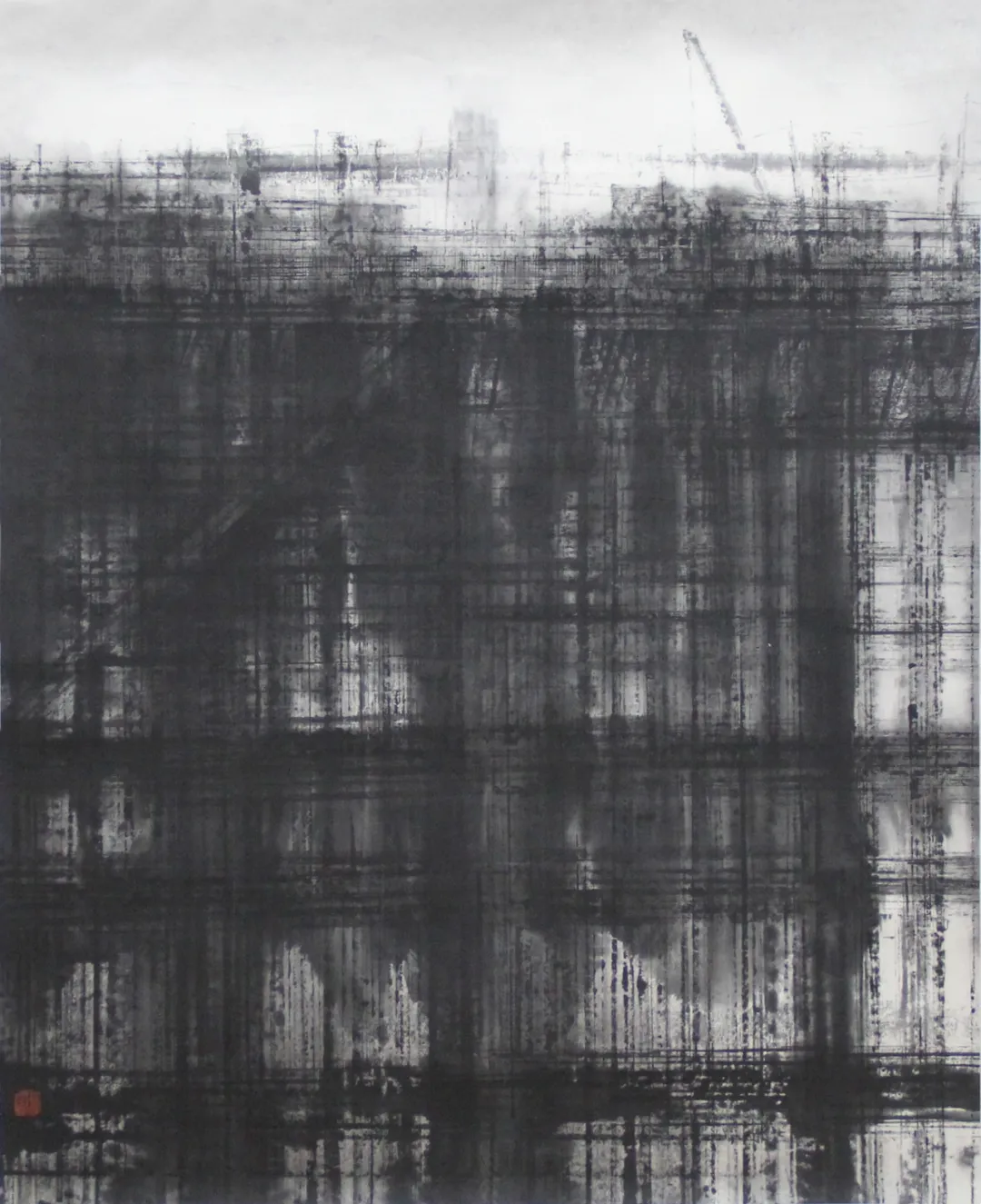
The choice of subject matter for a painting is closely related to the depth of its artistic conception. The painter Xu Danbin, putting aside the bustling city life and temporarily shielding the landscapes, flowers, and birds he holds dear, selected the earliest images of urban construction as the lyrical repertoire for his 'Growth Series.' Where does a new city come from, and where is it headed? What does it carry, and what carries it? Such simple yet heart-touching 'questions' are crystallized in his selection of subjects. I truly admire his perspective, not that of a philosopher but that of a 'philosophical' observer. Just as towering buildings rise from the ground up, isn't the beginning of the grand history of urban development marked by scaffolding and gradually rising structures? The vibrant city always blooms tirelessly, irrespective of day or night, heat or cold—these are the builders whose efforts overlap with the scaffolding. This poetic narrative sparks a distinctive luminescence that collides intensely with Xu Danbin's inner pursuit, giving rise to a surge of creative impulse. Nowadays, these impulses manifest repeatedly in his works, imbued with emotional warmth on the canvas. They carry Xu Danbin’s sincerity and admiration, not only offering heartfelt attention to the builders but also presenting the lively spirit of a city shaped by reform and opening-up, where its culture and humanity are in harmony. As a 'witness of history,' the 'Growth Series' undoubtedly serves as a valuable annotation. It is no wonder that his vision in choosing subject matter and in thematic depth is remarkable. Standing alongside the elder generation of urban ink painters, Xu Danbin praises the era, allowing viewers to witness the hope and progression from the senior ink artists to the emerging and new generations of the city’s artistic lineage.
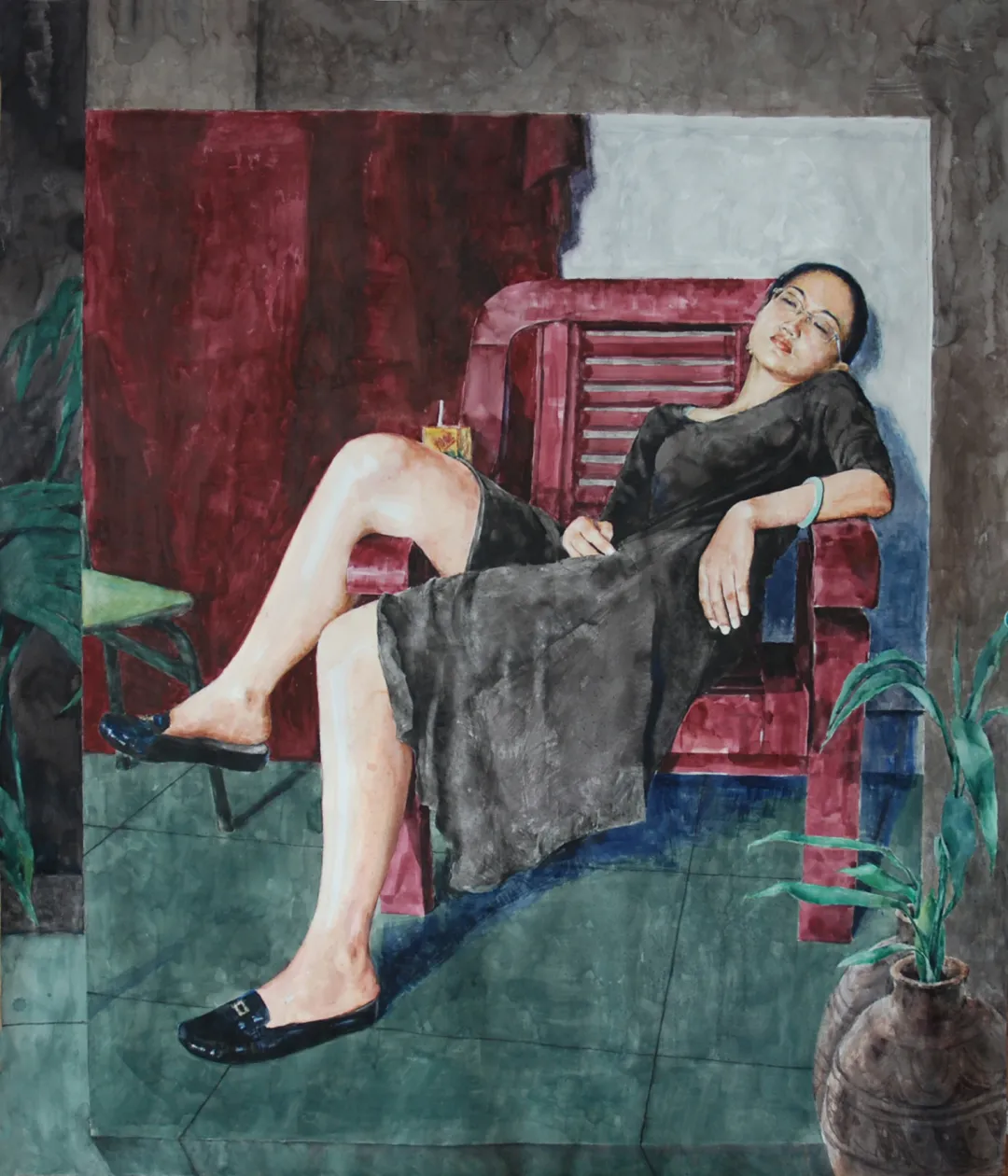
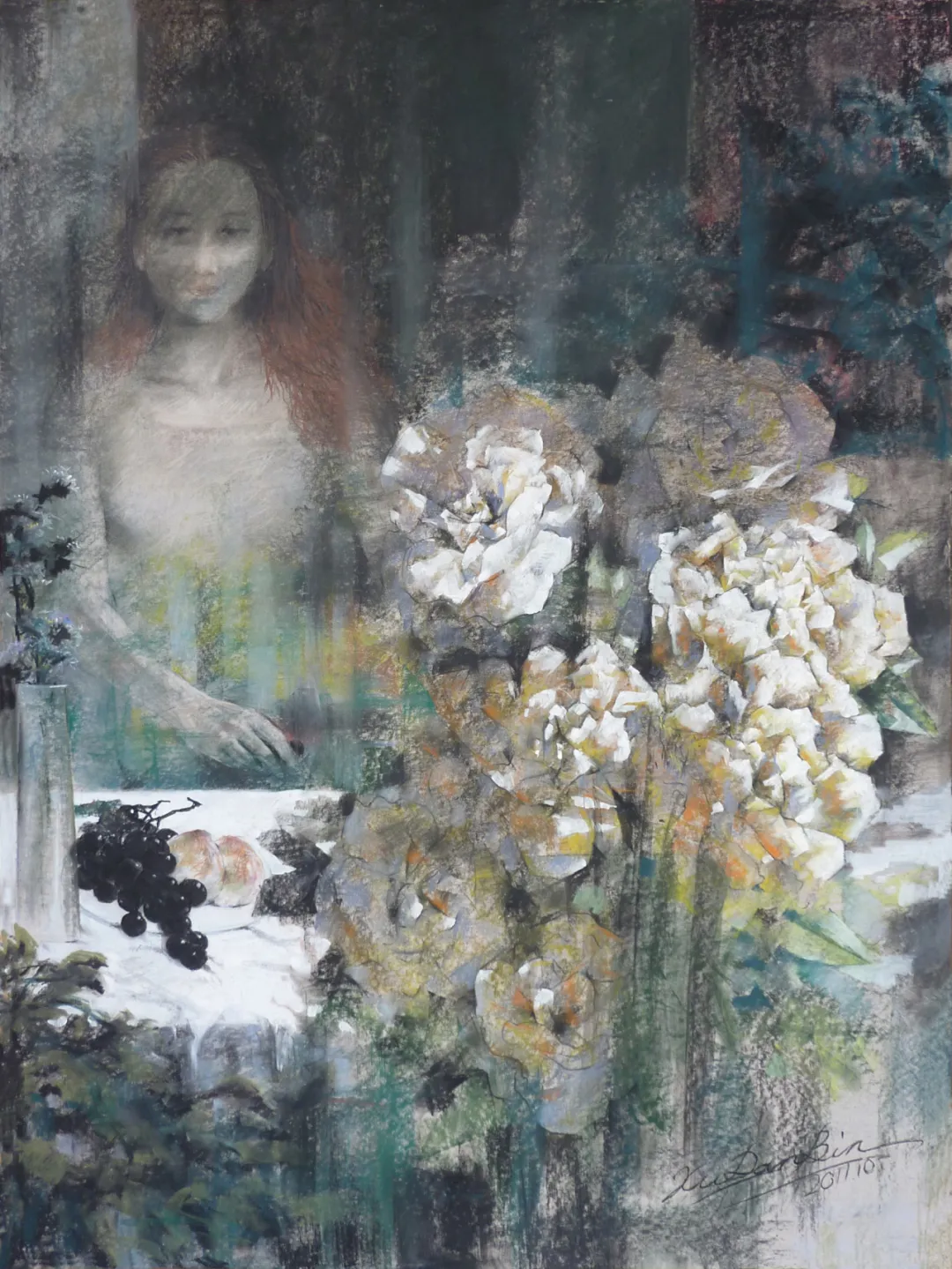
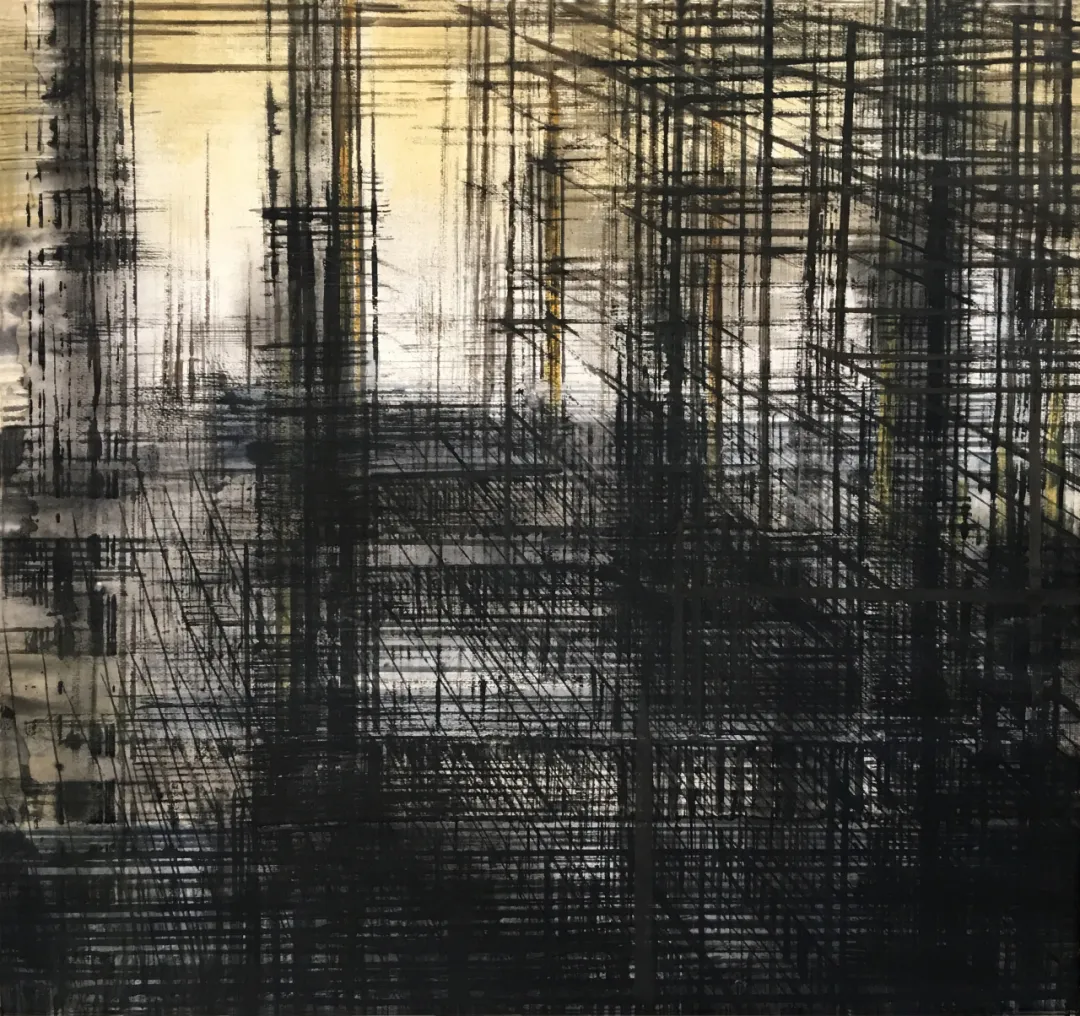
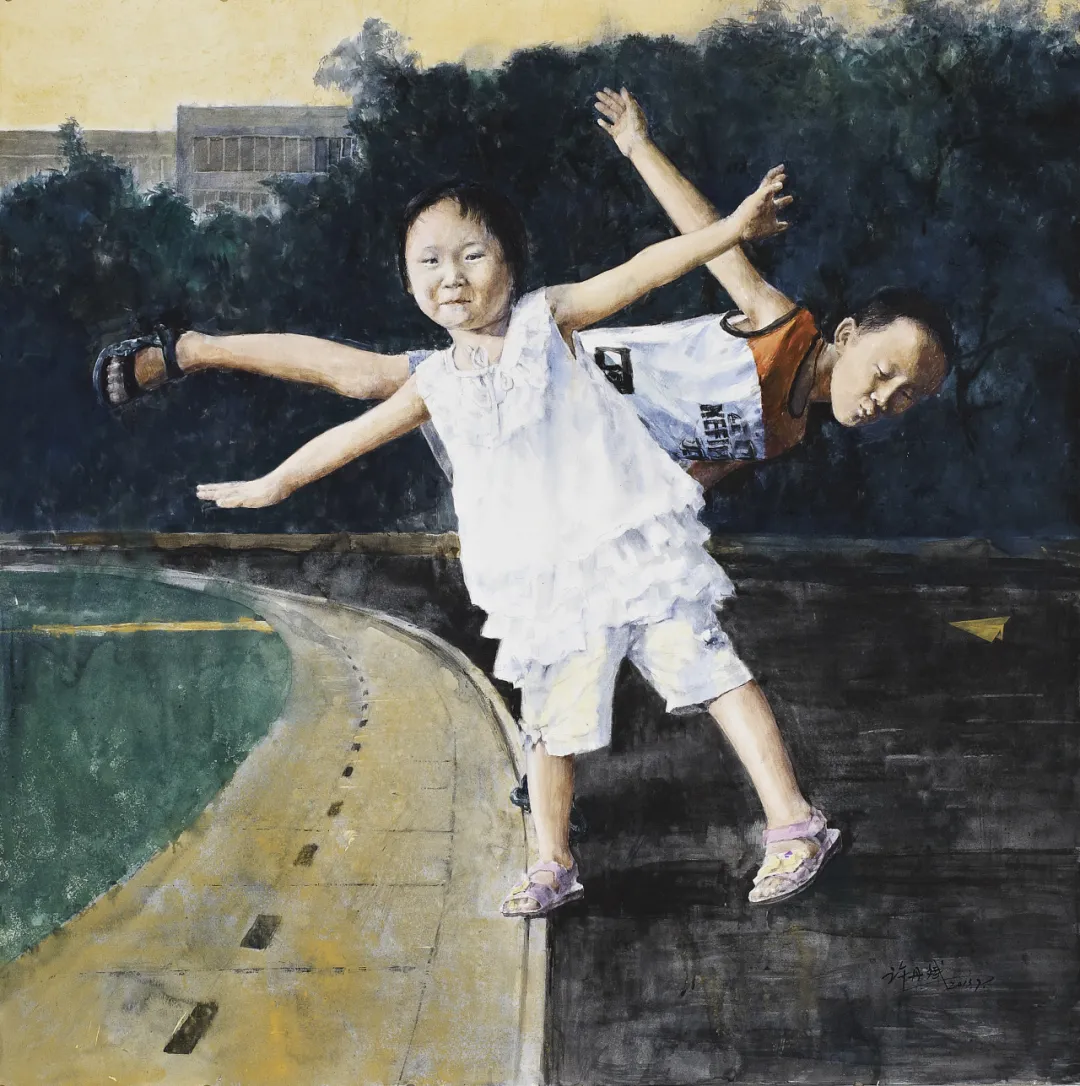
Xu Danbin's "Growth Series" is expressed through different painting mediums such as traditional Chinese painting, oil painting, and watercolor, serving as a grand tribute to the era. Structurally, he departs from the traditional approach of shaping landscapes with contour lines, instead using straight, geometric lines to form shapes. This shift completely sheds ancient conventions, reflecting a carefully considered conceptual change and a consolidation of new techniques. He emphasizes that brushwork relies entirely on lines, using their fine and rigorous organization to convey both the weight and texture of forms while creating a sense of width and depth in the visual space. His evocative patterns, developed through cross-disciplinary absorption, have become his own "visual symbols." Some view composition like playing Go—occupying more space with fewer pieces or less space with more—but I believe this characterizes Xu Danbin's approach. He allows intention to shape form, realism to convey truth, with lines deeply immersive, lyrical, and expressive, imbued with passionate expression and distinctive traits. Moreover, he balances light and dark in his lines and colors, uses warm accents, employs spotlighting to highlight focal points, and explores both internal and external space. Reading his "Growth Series" is like viewing silhouettes bathed in morning light, where contrasts between light and dark provide both grandeur and charm. Qing dynasty painter Shi Tao’s words resonate in his work: "Methods have no fixed form; it is the vigor and spirit that become the composition." The city is a forest sustained by the hands of workers, with solid logic and steadfast structures. Within the uniqueness of his brushwork, one can sense the rhythm of a city moving from yesterday toward tomorrow.
He once told me that in order to create this series of masterpieces, he would often toss and turn over his sketches, working tirelessly, repeatedly revising, adding and subtracting elements, and even constantly changing compositions and forms. He never sought absolute perfection, but strove to get as close as possible, until the sketches were finalized. Even when working on the sheets, if inspiration struck, he wouldn't hesitate to completely change the approach. A perceptive artist always demonstrates a subtle control on paper, and this lively impulse of inspiration and exploration may be one of the factors that enabled him to complete his work with such high quality.
He began painting at a young age in a rather informal, playful way. During his school years, he gradually focused more on brush and ink techniques, studying under masters step by step from Puning County to downtown Shantou. As a result, his higher aspirations and broader vision gradually stood out. He studied with Yang Heming and Professor Lin Fengsu of the Guangzhou Academy of Fine Arts. Unlike most artists who move from school to school, his experiences were different. He once worked in advertising painting and design in Shenzhen, which was extremely stressful, yet he often felt a sense of pride from it. After coming to Shenzhen, he engaged in art and design education while continuously creating paintings in his spare time. Although his rich experiences were somewhat varied, they became a foundational backdrop, solidifying the canvas of his life, with the mixture of joys and hardships more or less reflected and internalized through his brushwork.
The greatness of his intention lies in art reflecting the times. His 'series of growth' integrates pure lines, dense textures, strong structures, and prominent forms into a whole, using overall rhythm and artistic conception within a stable order to construct an aesthetically concrete vision with depth and perspective, capturing the vibrational resonance between humans and the city. By starting anew and venturing into urban ink painting, he acts like a 'signpost,' providing insightful guidance in the selection of materials, structure, form, and brushwork. The world of ink painting, the path of innovation, is vast. He expands the scope of 'urban ink painting' by incorporating different painting techniques such as oil painting and watercolor, creating a harmonious exploration of the central theme, demonstrating that his inner expression transcends both art forms and the emotional distance between people and the city. This reveals the value of urban spirit, allowing people to appreciate the symbiosis of the city and history, and the ever-present drive for innovation.
A Western saying goes: 'All art is a transition toward a musical state.' In the art world, there are always phenomena of sudden emergence, which I like to liken to a sonata in a symphony. The urban ink painters of Shenzhen are the assembled performers, collectively striking a powerful chord for the era. In a fleeting moment, the orchestra suddenly falls silent, and a bright flute sound slices through the air, spreading slowly. This is a distinctive display by Xu Danbin, reciting with musical fervor the vigorous past and brilliant future of Pengcheng.