
Curating the "Second Sun": Art as Spiritual Resilience in Manhattan’s Vertical Living
Curating the "Second Sun": Art as Spiritual Resilience in Manhattan’s Vertical Living
A Strategic Analysis on Interior Semiotics and Psychological Anchoring in High-Density Urban Environments
By: ARTDAFEN Strategy & Research Division
Context: Manhattan Residential Art Advisory & Curatorial Strategy
Executive Summary: The Crisis of the "Concrete Womb"
In my three decades navigating the global art market—from the vaulted halls of Art Basel to the private viewing rooms of Chelsea—I have observed a distinct paradox in Manhattan’s luxury real estate sector. We build higher, encasing ourselves in glass curtain walls that offer panoramic dominance over the skyline, yet a significant portion of the city's elite inhabit what I term the "Vertical Void."
For the high-performance demographics of Wall Street and Big Law, the luxury apartment often ceases to be a home and becomes a decompression chamber. These individuals frequently depart before dawn and return long after dusk. When the view outside is merely the black abyss of the Hudson River or the intrusive artificial glare of the grid, the interior space risks becoming a sterile, sensory-deprived environment.
The Curatorial Imperative: In this specific context, art is not decorative; it is functional. It is a psychological counterweight. When the physical window fails to provide natural light or connection, the canvas must become the "Second Sun." It acts as a spiritual anchor, providing the sensory texture, light simulation, and emotional warmth that the architectural envelope lacks.
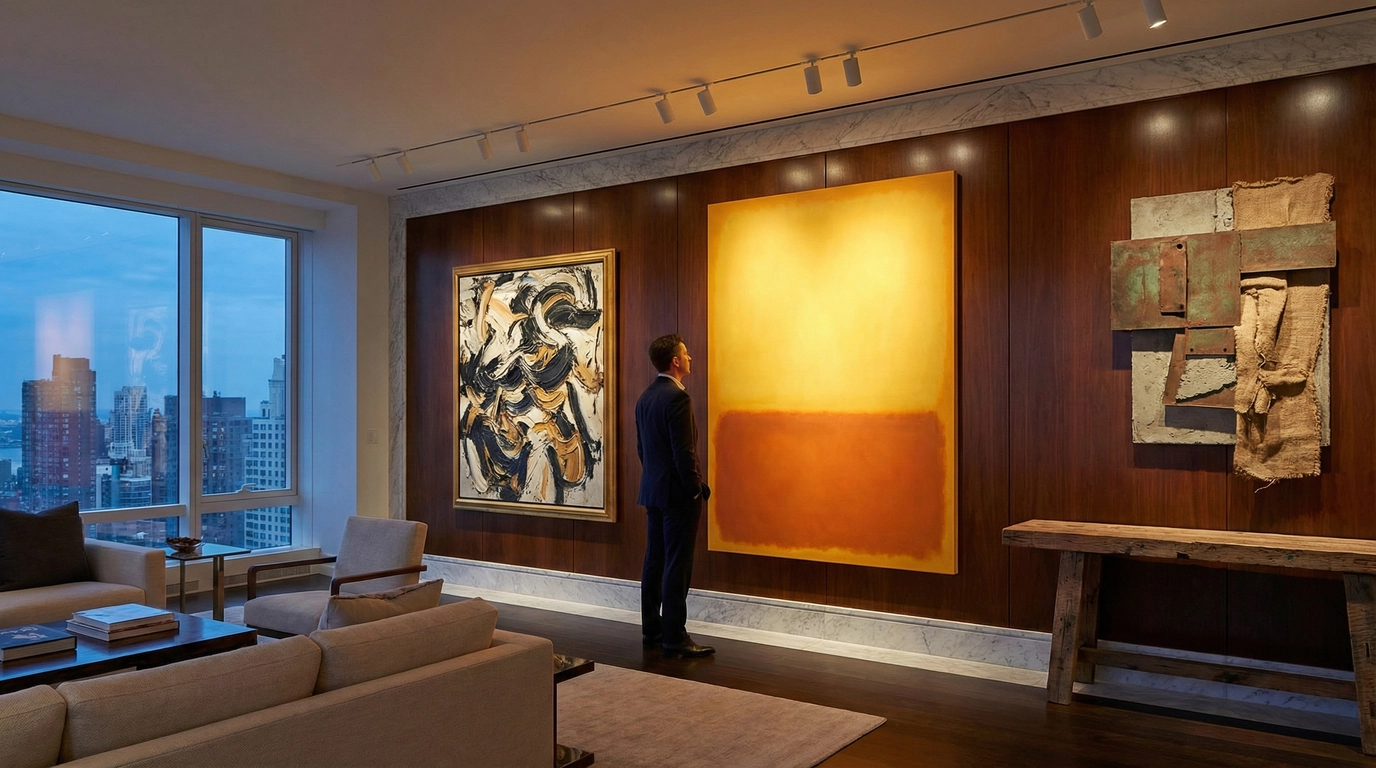
I. The Manhattan Vernacular: Strategic Curatorial Pillars
To curate successfully for this demographic, we must move beyond aesthetic matching. We must select genres that engage in a "dialogue" with New York’s cultural DNA while solving the psychological deficit of the sunless experience.
1. The Neo-Abstract Expressionist Intervention
- The Cultural Logic: This is the indigenous language of New York City. The ghost of the New York School (Pollock, de Kooning, Kline) still haunts the grid.
- The Spatial Function: In a room defined by rigid straight lines—mullions, beams, hardwood floors, and polished marble—the gestural brushstroke introduces organic chaos and necessary humanity.
- The Psychological Anchor: For the exhausted executive, the heavy impasto (texture) of oil paint offers "tactile friction." It reminds the viewer that a human hand created this, countering the automated, algorithmic nature of their workday. It is a vessel of raw energy that allows for silent catharsis.
2. Color Field & Luminism: The Artificial Circadian Rhythm
- The Cultural Logic: Channeling the legacy of Mark Rothko or the perception theories of James Turrell, this style rejects figuration in favor of pure sensation.
- The Spatial Function: This is the direct antidote to the "dark room." We curate large-scale works utilizing warm spectrums—Cadmium Yellows, Deep Ochres, and Vermilions.
- The Psychological Anchor: Under high-CRI (Color Rendering Index) museum lighting, these canvases do not just reflect light; they seem to emit it. They provide a "Psychological Hearth," simulating the enveloping warmth of the sun that the resident missed during their 14-hour workday. It creates a sense of safety and "holding" within the vastness of the city.
3. Industrial Materic Aesthetics
- The Cultural Logic: A homage to the Tribeca/SoHo loft heritage—cast iron, cobblestone, and urban grit.
- The Spatial Function: Utilizing mixed media (oil, cement, oxidized metal, burlap) to create dense, physical surfaces.
- The Psychological Anchor: Grounding. High-rise living can feel unmoored, literally "up in the air." Art that possesses weight, roughness, and architectural geometry provides a sense of stability and permanence—a "root" in the sky.
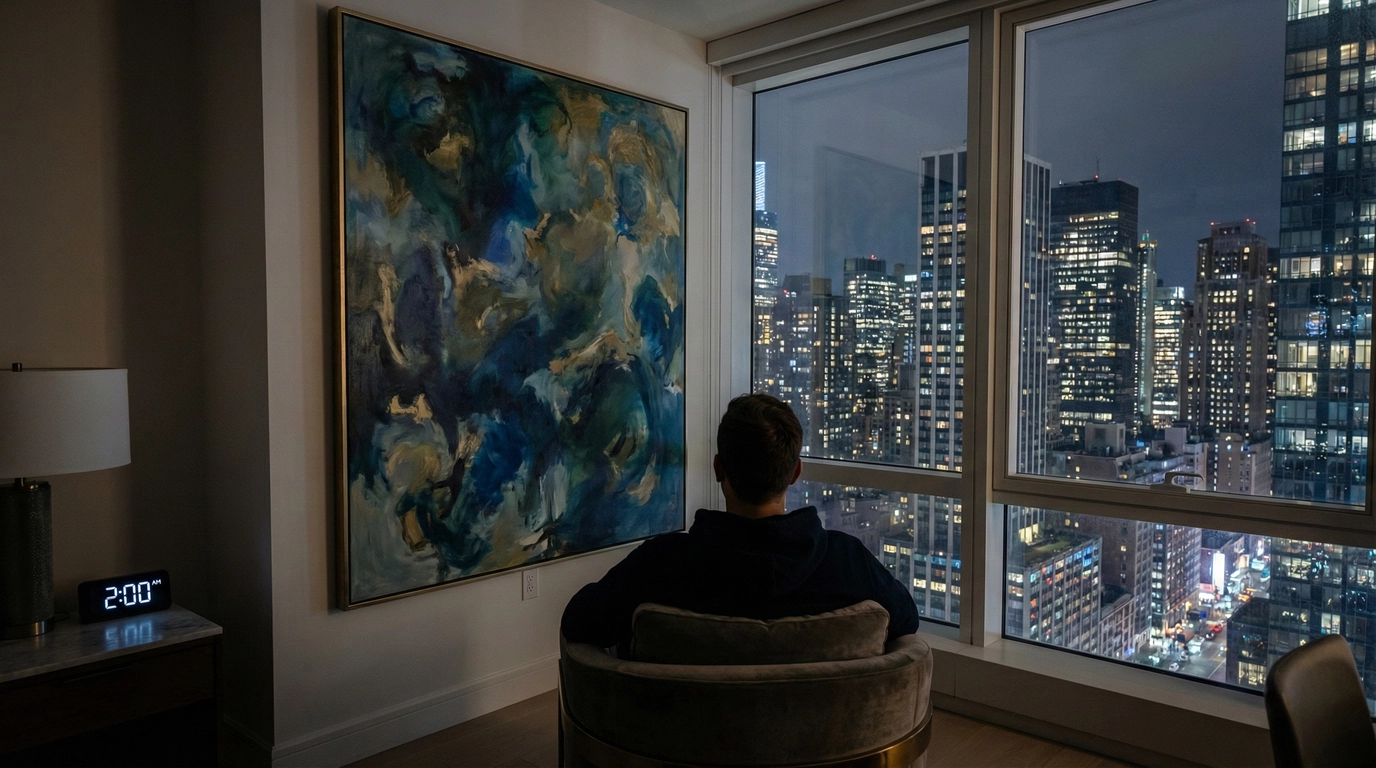
II. The Neuroaesthetics of "The Gaze"
Why do we define oil painting as a "spiritual anchor"?
From a neuroaesthetic perspective, staring into a complex, non-figurative oil painting activates the default mode network (DMN) of the brain—the same network active during deep meditation. For the Manhattanite who sees no horizon line, only neighboring towers, the painting allows for "Mental Travel."
It breaks the claustrophobia of the enclosed space. The canvas becomes a portal. The viewer is no longer trapped in a glass box; they are transported into the artist’s reality. It is the ultimate act of reclaiming one's humanity at 2:00 AM.
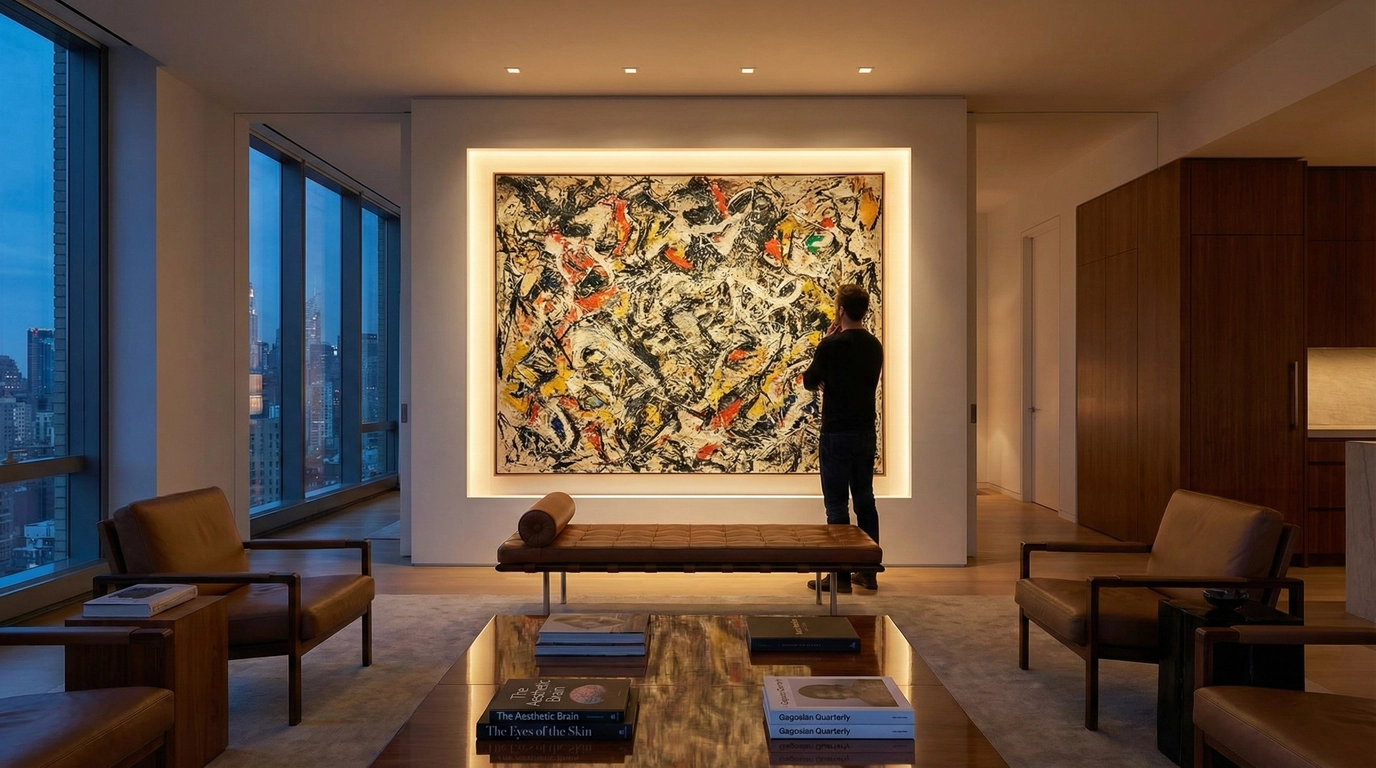
III. Selected Curatorial Bibliography & Critical Discourse
(A compendium of seminal texts and industry analysis supporting the "Art as Environmental Therapy" thesis)
To fully grasp the interplay between high-density urban living and the restorative power of fine art, the ARTDAFEN Research Division references the following literature. These sources form the theoretical framework for curating specifically for the Manhattan vertical context.
1. On Spatial Psychology & Neuroaesthetics
The scientific basis for why the brain craves texture and color in sterile environments.
- Chatterjee, Anjan. The Aesthetic Brain: How We Evolved to Desire Beauty and Enjoy Art. Oxford University Press.Curator’s Note: Essential reading for understanding the biological response to abstract art. Dr. Chatterjee’s research highlights how visual complexity (like that found in Abstract Expressionism) triggers the default mode network (DMN), offering a neurological counter-balance to the high-beta wave state of corporate stress.
- Pallasmaa, Juhani. The Eyes of the Skin: Architecture and the Senses. Wiley.Curator’s Note: A foundational text in architectural phenomenology. Pallasmaa argues against the "dominance of the eye" and pleads for a tactile architecture. In the context of the sleek, glass-walled Manhattan apartment, this text justifies the need for heavy impasto and "haptic" art to re-ground the resident.
2. The Manhattan Canon: History & Market Context
Understanding the indigenous visual language of New York City.
- "The New York School: The Legacy of Action." Gagosian Quarterly.Curator’s Note: This publication explores the lineage from Pollock to contemporary abstraction. It frames the "New York style" not just as history, but as an ongoing dialogue with the city's energy—crucial context for collectors looking to buy art that "belongs" in a Manhattan skyscraper.
- Saltz, Jerry. How to Be an Artist (Excerpts on "The Studio as Sanctuary"). New York Magazine / Vulture.Curator’s Note: Pulitzer Prize-winning critic Jerry Saltz often articulates the visceral, almost religious experience of confronting art in New York. His writings provide the emotional vocabulary needed to explain why a painting is more than an asset class.
3. Technical Integration: Lighting & Interior Architecture
Practical methodologies for displaying art in natural-light-deprived zones.
- "Illuminating the Void: Advanced Art Lighting Solutions for Urban Lofts." Architectural Digest (AD) Pro.Curator’s Note: An industry-standard reference for integrating high-CRI framing projectors. It addresses the technical challenge of simulating "daylight" on a canvas without damaging the pigments, transforming a dark hallway into a luminous gallery space.
- "The Private Museum: Living with Monumental Art." The TEFAF Art Market Report.Curator’s Note: This report validates the strategy of treating the artwork as the "primary light source" and emotional center of the residence, rather than mere decoration.
IV. Strategic Conclusion
The convergence of these aesthetic philosophies suggests a singular conclusion for the Manhattan collector: In the vertical city, the artwork assumes the agency of nature.
When the sun is absent, the painting must shine. When the city is cold, the texture must be warm. We are not merely curating a collection; we are engineering a sanctuary for the human spirit amidst the steel.
ARTDAFEN remains committed to filling that canvas with history, quality, and emotion.