
In Dafen Oil Painting Village, they make a living by painting.
On May 28, the "Worker's Daily" published a feature article titled "Living by Painting" by journalist Liu Youting in its entire section, and simultaneously released the article and documentary "The Dafen Twin Dreams" on its public account. The "Worker's Daily" presents the real life and industrial ecology in Dafen Oil Painting Village through detailed interviews with several painters. Below are the documentary and the full text.
Zhao Fenggang's day mostly starts at noon. After a simple wash-up and a little food, he will stay in the living room filled with easels. When he doesn't feel it, he might not be able to paint much all day. But when the 'feeling comes,' he can paint all the way until early the next morning.
In 1989, Hong Kong art dealer Huang Jiang came to a village called Dafen in Shenzhen, Guangdong Province. He took note of Dafen's low production costs and its proximity to Hong Kong, bringing people there to copy and reproduce oil paintings for sale overseas. This is how the initial shape of the Dafen oil painting industry was formed.
Now, 36 years later, Dafen Village has become the largest oil painting production and trading base in the country. When people mention it, they tend to habitually add the words 'oil painting village' at the end. There are now thousands of galleries and art institutions there, with over 8,000 related professionals, including the painter Zhao Fenggang.
In Dafen Village, the meaning of the verb 'to paint' has been constantly changing and expanding; the upstream and downstream chains surrounding 'painting' have also been continuously extending. As long as one is willing, everyone can find a foothold in this chain.
Dafen Village is not big, but in the face of the question 'how to make a living from painting', it can accommodate hundreds or even thousands of answers.
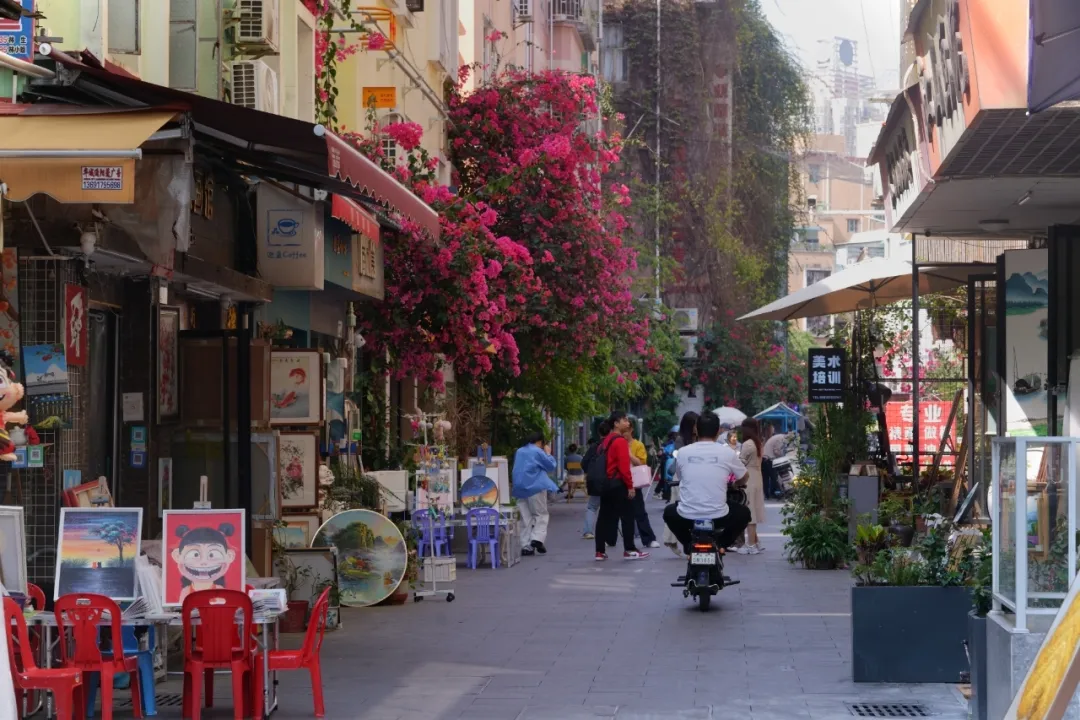
In Dafen Village, elements related to painting can be seen everywhere. Photo by Liu Youting, Worker Daily client.
The more you paint, the more you earn.
Twenty years later, when recalling the scene of his first visit to Dafen Village, Zhao Feng's tone still carries a hint of surprise, "Before that, I never thought that painting could become a way to make a living."
Without graduating from high school, Zhao Fenggang left his hometown in Gansu and headed south, working along the way. He has worked at construction sites and assembly line factories. When he first arrived in Shenzhen in 2004, Zhao Fenggang was only 18 years old.
One day, while looking for a job on the street, he was attracted by a 'misplaced' recruitment advertisement that read 'Hiring an artist, preference for those with a foundation.' Following the address, Zhao Feng found the studio located in Dafen Village. 'Give it a try,' the boss casually handed him a picture and asked him to paint it.
Zhao Feng has liked painting since he was little. In school, he took watercolor and gouache classes in interest groups, but he had never painted with oil paint. Relying on that little 'foundation', he forced himself to copy the sample piece stroke by stroke. 'As a beginner, it's not bad,' the boss nodded and decided to keep him. 'The monthly salary was less than 1000 yuan, similar to that of workers in nearby factories,' Zhao Feng recalled.
At that time, after more than a decade of development, Dafen Village entered a stage of producing a large number of commissioned paintings. The so-called 'commissioned paintings' means that the client provides a picture, and the artist paints exactly that picture; the client specifies how many pieces are needed, and the artist produces that many. Whether it's landscape painting, portraiture, or famous global artworks versus ordinary photos, there are artists who can paint them all. In addition to the street-side studios, the village also has a number of painting factories—within workshops similar to production facilities, hundreds of artists gather together to paint according to orders.
After becoming familiar with the materials and basic techniques of oil painting, Zhao Feng made quick progress. In less than a month, he was already able to independently complete most of the commissioned paintings. Three months later, he moved to a studio where he was paid by the piece, 'At that time, I could earn about 30 yuan for one painting, so the more I painted, the more I earned.'
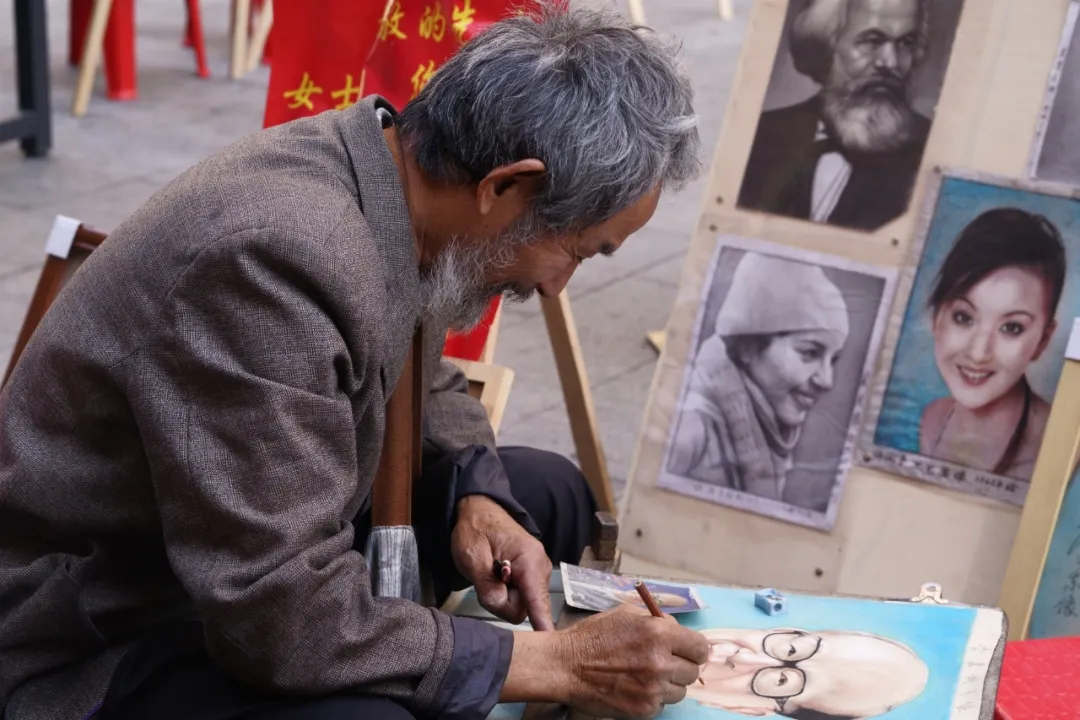
On the streets of Dafen Village, an artist is painting a portrait. Photo by Liu Youting, Worker’s Daily client.
It was in the year when Zhao Feng first began to support himself through painting that Dafen Village became the only sub-venue for the Shenzhen International Cultural Industry Expo and Trade Fair. This unique industrial model of the 0.4 square kilometer village gained more attention, with a massive influx of orders, marking the peak period for the Dafen oil painting industry.
Lin Jianhong from Guangxi personally experienced such a peak. In early 2008, after having painted commissioned works in several cities, Lin Jianhong moved to Dafen Village and joined a painting factory with nearly 500 employees as a painter. He said that there, facing a huge number of repetitive orders, the painters did not paint "one by one" but rather "in rows." Dozens of canvases were lined up side by side, starting with a unified sketch, then applying the base color, followed by layering the mid-tones, and finally refining the details.
According to this painting method, Lin Jianhong can complete nearly 30 pieces of artwork measuring one square meter every day.
When painting in rows, there are also some small techniques, such as making sure to mix more colors in advance. 'Because it's very difficult to achieve the exact same color after mixing again, if there are color differences in the same painting, it will take more time to cover and modify,' Lin Jianhong explained.
In those years at the painting factory in Dafen Village, during busy order times, the painters couldn't go home at all. When they were tired, they would lie down on the packing boxes beside them for a quick nap and then continue painting after waking up. Besides painting, the factory also had to cut paper, laminate, and assemble frames, but no matter how loud the machines were, the painters could still sleep soundly.
However, not long after I arrived in Dafen Village, such scenes gradually disappeared, and now they can no longer be seen at all," said Lin Jianhong.
"What can be drawn" and "What I want to draw"
When Lin Jianhong first started working at the painting factory in Dafen Village, he earned about 6,000 yuan a month. Around him, many senior painters were earning over 10,000 yuan a month. Even in Shenzhen, this was considered a decent income at the time.
However, the highlight of batch orders could not be maintained. In 2008, the international financial crisis broke out, and soon the volume of oil painting export orders from Dafen Village plummeted. By the end of that year, the factory where Lin Jianhong worked had almost no orders to accept. He resigned and shared an apartment with other painters in the village, using the bedroom for living and the living room for painting. Lin Jianhong began to independently 'search for orders' and 'accept orders'.
In the early stages of the rise of the oil painting industry in Dafen Village, the main sales channels were through large art dealers who placed orders or made purchases. As the scale of development grew larger, studio owners and painters gradually opened their own shops to engage in retail, while also taking on orders from individual clients. To this day, this remains one of the important industrial formats in the area.
Lin Jianhong said that at that time, the houses rented by the painters would mostly have their doors open during the day, partly to let the paint dry, and partly to wait for someone to come by the stairs and alley to give them orders.
The first e-commerce platform store owner who stabilized cooperation with Lin Jianhong walked into his living room like this, holding a photo in hand, asking: 'Can you draw this?'
Lin Jianhong glanced at it; it was a "Nine Carp Painting" with nine koi circling around a lotus. "It can be painted," he replied.
In those two years, images symbolizing wealth and good fortune, like the money tree, peony flowers, and Golden Mountain, were 'bestsellers' in the domestic oil painting market, and Lin Jianhong painted them frequently. At that time, smartphones had not yet become widespread, and in most cases, he completed his copies by looking at printed photos.
It's not as simple as it looks. Not long ago, Lin Jianhong asked a friend who graduated from an art academy to copy an ordinary landscape picture, but he couldn't recreate the texture shown in the image no matter what.
"To paint that picture well, the key is to first create a relief effect on the canvas using modeling paste, and then apply the base color and brush strokes," said Lin Jianhong. In order to reproduce various samples with oil paint, the artist, who comes from a painting factory background, has developed a complete set of techniques and also utilizes many tools apart from brushes. 'Without the experience in a painting factory, many formally trained individuals would also struggle to achieve good results.'
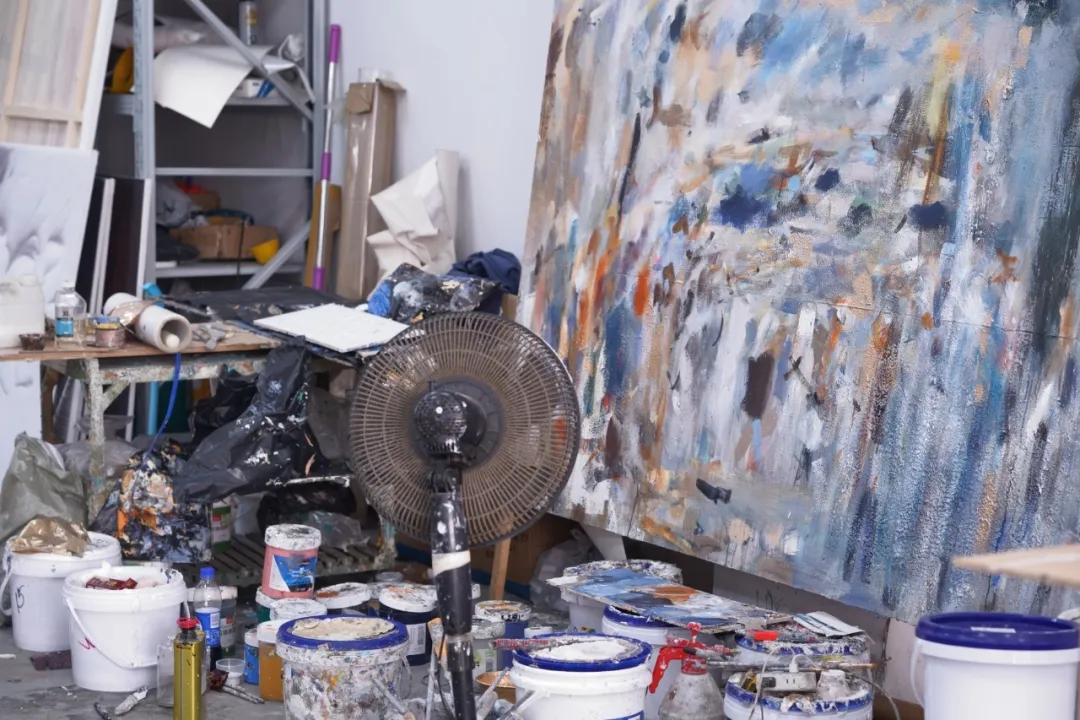
In a corner of Lin Jianhong's studio, there are paints, brushes, and unfinished oil paintings. Photo by Liu Youting from the Worker’s Daily client.
Yang Fuxu, who is also from Guangxi like Lin Jianhong, is a professional artist. In 1999, he came to Dafen Village and chose to paint relatively niche watercolor replicas that require a higher level of expertise. For about two years, he lived in a house shared with four others, leading a life of reversed day and night; sleeping during the day and painting at night.
Through continuous copying, Yang Fuxu's basic skills in painting improved, but the long-term repetitive work gradually made him feel bored. 'Painting commission pieces seems simple, but in reality, due to the pursuit of high fidelity, it's not easy for the artists to do, and there's almost no space for personal expression.'
Unwilling to 'paint according to others' demands', in 2001, Yang Fuxu left the studio where he was employed and became one of the earliest painters to explore original art in Dafen Village.
Dafen Village started with copied paintings, but almost from the beginning, there have always been people wanting to 'paint their own paintings.' Zeng Qingjin from Henan is the same age as Yang Fuxu. In his youth, he worked in several factories in Guangdong, and because he liked painting, he would set up a easel in his dormitory whenever he had free time. In 2013, after doing order paintings in Dafen Village for 10 years, Zeng Qingjin decided to stop taking orders and focus on original paintings.
Zeng Guifu from Fujian lived in Dafen Village for several years creating original paintings in Xiamen. At that time, whenever he had a little money, he would first buy enough canvas and paint for at least a month, and only then would he think about the issue of food. He said that to save money for painting, he didn't know how many bowls of noodles he ate back then.
However, for an artist to 'turn around' and become a painter, simply having a passion is obviously not enough.
You need to eat and express yourself.
Recently, on the easel set up around Zhao Feng's home, there were several unfinished paintings. One of the paintings had a warm color scheme overall, depicting a group of children happily walking forward, while only one turned back, revealing a devilish face.
These semi-finished products are a series of works expressing the theme of humanity that Zhao Feng is currently creating, inspired by a news story about campus bullying. Around them, scattered are the order paintings he has received from various sources. He said this is 'supporting creations with paintings' - using the stable income from order paintings to fund the creation of original works.
After the international financial crisis, the foreign trade orders for oil paintings recovered slowly. Under the guidance of the local government, Dafen Village began to transform and increase support for the original painting industry.
The shift in the market and policies has pushed many people like Zhao Fanggang, who have always been drawing orders, to a crossroads in their careers. "Deciding whether to create original art is not a matter of choice, but a question of survival," Zhao Fanggang said.
Since Zeng Qingjin left the ordered painting system, he has lost a stable source of income. Once the things he painted could not be sold consistently, his wife's income from her job was hardly enough to cover the household expenses, and the two often found themselves in the embarrassing situation of borrowing money to get by.
In 2015, Zhao Fenggang rented a store in Dafen Village to sell his paintings. "As a result, business was dismal," he said with a wry smile. When years of artists being focused on 'copying and pasting' began to 'express themselves', the market didn't respond by placing orders as it had before.
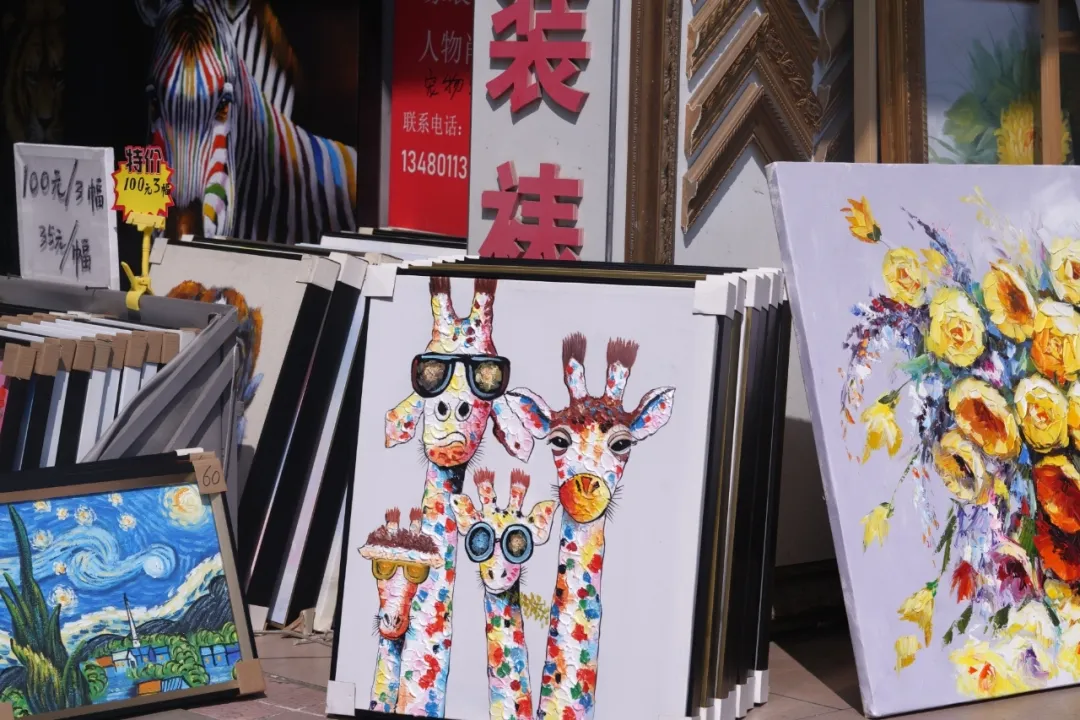
In Dafen Village, many shops display the oil paintings for sale in front of their doors. Photo by Liu Youting, Worker’s Daily app reporter.
In a similar situation, Yang Fuxu also went through it. In 2007, he self-financed his studies at the Central Academy of Fine Arts. That year, he visited many art exhibitions, met many people, and heard many viewpoints. After returning to Dafen Village, Yang Fuxu tried to internalize what he had learned and experienced into his own style, spending more than two years to complete a series of environmentally themed artworks, "using the migration of fish schools as a metaphor for changes in the ecological environment."
However, for several years after that, this series did not find any buyers.
Even if a work is sold, it does not mean that 'everything is fine.' In 2016, Zeng Qingjin used scraps of fabric as painting materials, and through methods such as pasting, tearing, and covering, completed a large-scale work measuring 2 meters high and 5.4 meters long, which was sold for a high price.
"I once thought I had succeeded," said Zeng Qingjin, but his subsequent paintings did not sell well as a result, "the uncertainty in the art market is too strong."
When the sample drafts and the client's requirements are no longer the standard for painting, and when the fate of each painting has to be determined by 'opening a blind box', what to paint is a problem that artists seeking 'freedom' often encounter. For an entire year, Zhao Feng only managed to create two paintings. The ideas were there, the emotions were there, but when it came to revising, the painted images always felt like 'something was off'.
Zhao Fenggang's small gallery couldn't be maintained. He shifted his focus back to commissioned paintings and only dedicated part of his time to exploring original art, stating, 'You have to stay alive first in order to continue expressing yourself.'
Yang Fuxu still decided not to turn back. After the 'Great Migration of Fish' series met with a cold reception, he continued to create some original paintings that are more acceptable to the market while building his own painting style and language.
A few years later, Yang Fuxu used the姿态 of trees as the subject and created the "Dancer" series. This time, the market acknowledged him, and the series was exhibited in multiple art shows, selling successively at considerable prices. For Yang Fuxu, the greater gain was the broad recognition of his painting style, and soon after, the long-shelved "Great Migration of Fish" series also found buyers.
According to statistics, there are currently over 400 original painters in Dafen Village. In the past five years, nearly 200 works by Dafen painters have been selected for national and provincial art exhibitions.
Beyond the canvas
In 2012, when he had just moved from Xiamen to Shenzhen, Zeng Guifu once searched online for a question: Where is the richest place in Shenzhen?
At that time, he no longer created original paintings. "When the noodles at home were all eaten and the works still couldn't be sold, I felt it was time to change paths," said Zeng Guifu.
Compared to painting, it is clear that Zeng Guifu has had more luck in entrepreneurship. At the beginning, he partnered with friends to establish a mural studio in Xiamen, and the business was doing quite well. Shortly after arriving in Shenzhen, during one of his readings, he learned about the concept of 'participation'. At that time, social platforms were developing rapidly, and Zeng Guifu keenly noticed that more and more people were eager to share their experiences and feelings online. 'Can painting also be something that everyone can participate in?' Zeng Guifu asked himself.
In 2014, the first oil painting experience store in Dafen Village, operated by Zeng Guifu, opened.
Perhaps the concept was too advanced; in the early days, the business wasn't good. Some customers would reach the door, and upon hearing that "experiencing it would still cost money," they'd shake their heads and walk away. Some customers would sit in front of the easel, hesitating to make a stroke, fearing they would "ruin the painting." While Guifeng Zeng encouraged them verbally, saying "oil paintings can be repaired no matter how they're painted," he also held a brush and demonstrated the processes of laying color, glazing, and covering on the canvas again and again.
In 2017, during the Shenzhen Creative Industries Fair, when a temporary booth space became available organized by the host, Zeng Guifu was invited to set up a stall. Unexpectedly, it turned out to be the most popular booth of the day, with people lining up to paint oil paintings themselves.
"Letting people paint" and "painting for people" can both be profitable. After the Cultural Expo became a turning point, the business at Zeng Guifu's shop became thriving, and they gradually introduced various art services and event planning with painting as the core. In this process, more and more 'experience painting' signs appeared on the streets and corners of Dafen Village, becoming an important link connecting the local oil painting industry with countless ordinary people.
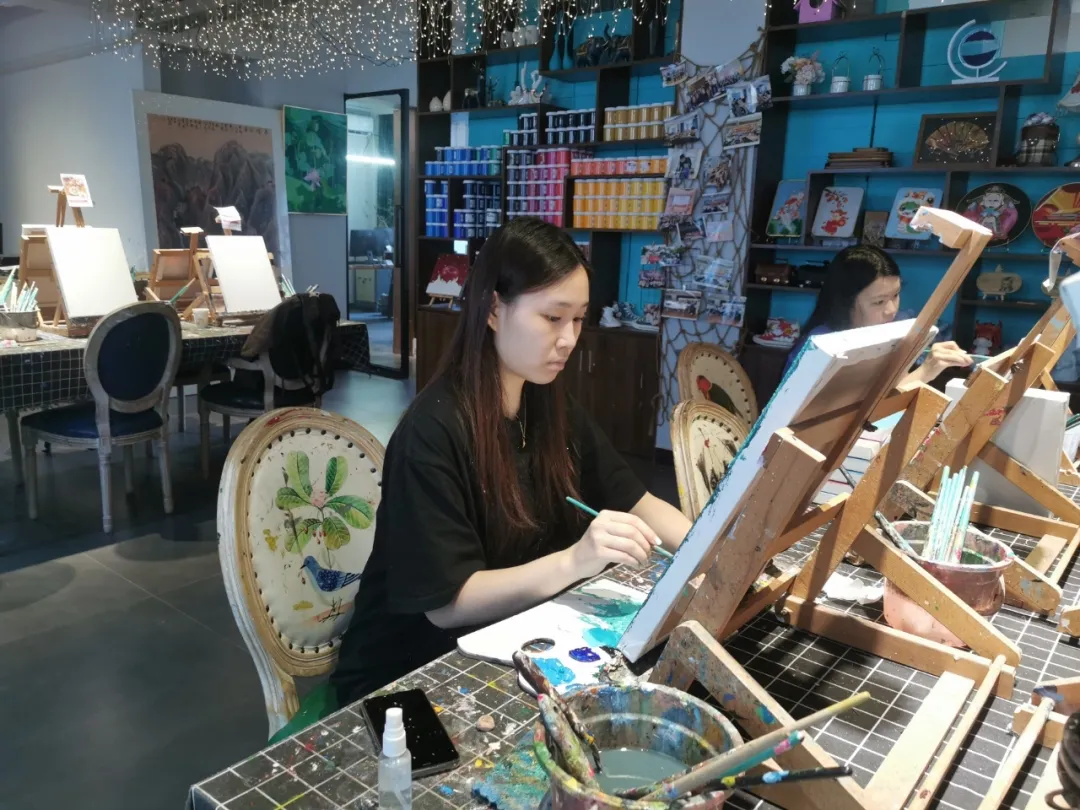
At Zeng Guifeng's oil painting experience hall, customers can start from scratch to create their own works.
In Dafen Village, the meaning of "making a living through painting" has long exceeded the boundaries of the canvas. In 2014, by chance, Lin Jianhong got a job to color the scenery for a theme park. The theme park had very high standards; the colors of each landscape had to match the color card exactly. Many art college students working together often had to redo their work because of this. Having restored thousands of samples, Lin Jianhong developed a very high sensitivity to color, adjusting colors quickly and accurately, which even surprised the experts present.
A few years later, Lin Jianhong participated in a landscape project for a large amusement park in Guangdong. One of his tasks was to completely age a replica ancient ship. He partnered with several other painters from Dafen Village, using their painting skills to add textures like rust, water stains, and corrosion from the cabin to the rivets, and from the wood grain to the paint surface, ultimately achieving a texture that was indistinguishable from real. Lin Jianhong said that this was also 'painting' an order, only the canvas had changed to the entire space.
Due to the good landscape effects, the team led by Lin Jianhong has successively won contracts for several other areas of the park. The originally planned three-month project ended up lasting four years.
Having stayed in Dafen Village for nearly 20 years, Lin Jianhong has never truly detached himself from the order-based painting system. In his view, as Dafen Village transforms, this system has also undergone significant changes. 'Rather than calling it an 'order painting,' it's better to refer to it as a 'custom painting,' Lin Jianhong said. The market demand still exists, but the requirements are vastly different. A good painter is no longer someone who mechanically repeats, but rather someone who must constantly improve, allowing order paintings to have their own value.
Gather together to coexist
Near the entrance of Dafen Village, the building that houses the TNT International Art Space is quite noticeable. Now, Zeng Qingjin has his own painting studio there.
In 2018, Feng Jianmei, who had been operating a photo frame factory in Dafen Village for many years, founded the TNT International Art Space. Her original intention was to break the stereotype that 'Dafen Village only has ordered paintings' and to create a platform for original artists to be seen more. However, once the project was actually implemented, Feng Jianmei realized that original artists needed more than this.
Creation is just one part of the painting industry. For a long time, most original painters in Dafen Village have been working alone, not only painting but also seeking channels to sell their works and negotiating prices. Because sales are unstable, some painters have to take on commissioned work to earn money, which interrupts the continuity of their creative process and drains their energy, making it even harder to sell their artworks for a good price. Over time, this can lead to a vicious cycle.
Opposite the TNT International Art Space is the T5 Contemporary Art Center, which will start operations in 2024. Long Jingchuang, the president of the Dafen Painting Industry Association, is the founder there. He came to Dafen Village in 1996 and has painted commissioned pieces, original works, and run a studio and decorative painting business. In his view, the path of originality has never been easy, and very few people can walk it independently like Yang Fuxu. For Dafen Village to become a hub of original art, a 'collective' model is essential.
Since the T5 Contemporary Art Center began operations, it has successively signed contracts with more than 50 artists, most of whom are local painters from Dafen Village. Now, the center is actively promoting the original art works of Dafen Village through exhibitions, academic exchanges, and other means in a team format.
At the TNT International Art Space, Feng Jianmei launched an artist residency program that not only provides free creative space for resident artists but also offers a series of services such as exhibition planning, artwork sales, and copyright management. "The goal is to allow artists to focus on their creation without any worries."
Zeng Qingjin is one of the earliest painters to join the residency program. After collaborating with the TNT International Art Center, Zeng Qingjin found that the long-lost sense of stability and ease had returned. "It's like when I was receiving orders, I just need to immerse myself in painting, but now I am painting my own works."
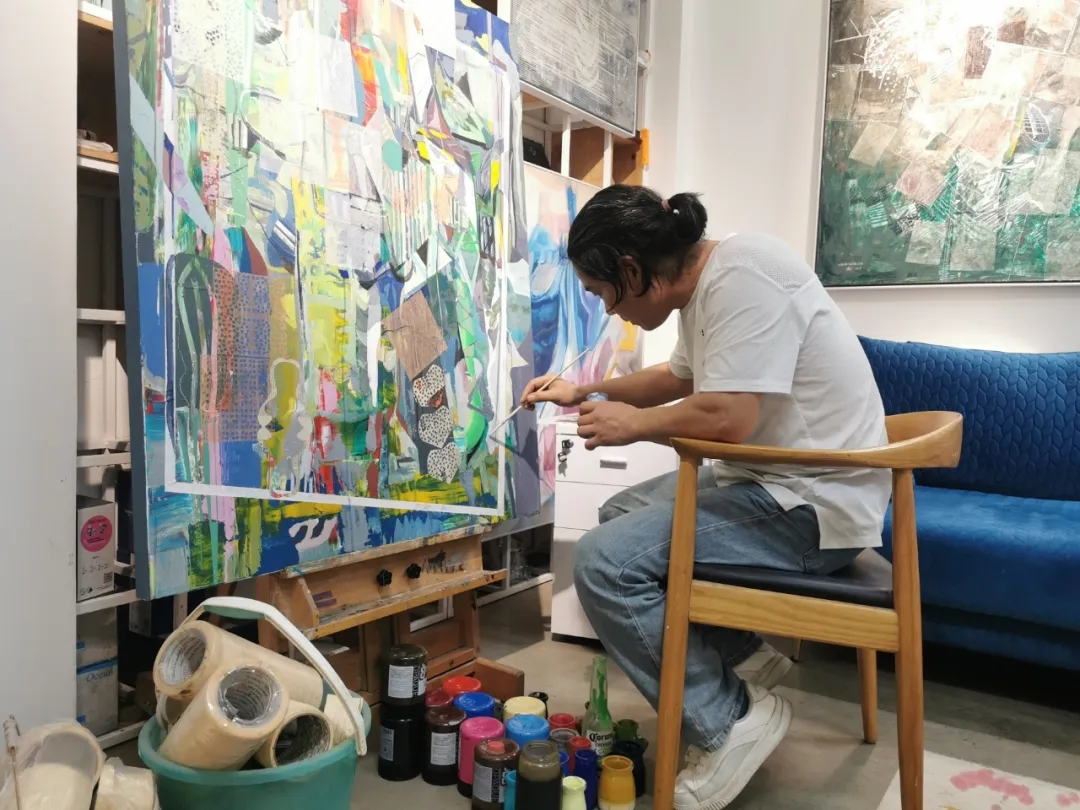
Zeng Qingjin is in the process of creation. Photo by Liu Youting, worker's daily client reporter.
The effects of shedding the burden are gradually becoming apparent. After nearly seven years, the painting style of Zeng Qingjin has stabilized, producing a series of works that are far more complete and systematic than ever before. With the professional operation of the art space, 'selling paintings no longer relies on luck and chance.'
At the entrance of Dafen Village, not far from the TNT International Art Space, there is a somewhat weathered sign that reads 'World Oil Painting · China Dafen'. Since starting to paint commissioned works in 2003, Zeng Qingjin has lost count of how many copies and original works have spread from Dafen Village to all over the country and even the world. Recently, he has had an idea; he hopes to take some time to return to his hometown in Henan to seek new creative inspiration, and then bring the finished products back to Dafen Village for exhibition and sale.
If Zeng Qingjin's plan can be realized, perhaps the phrase 'China Dafen' can be given a new meaning.