
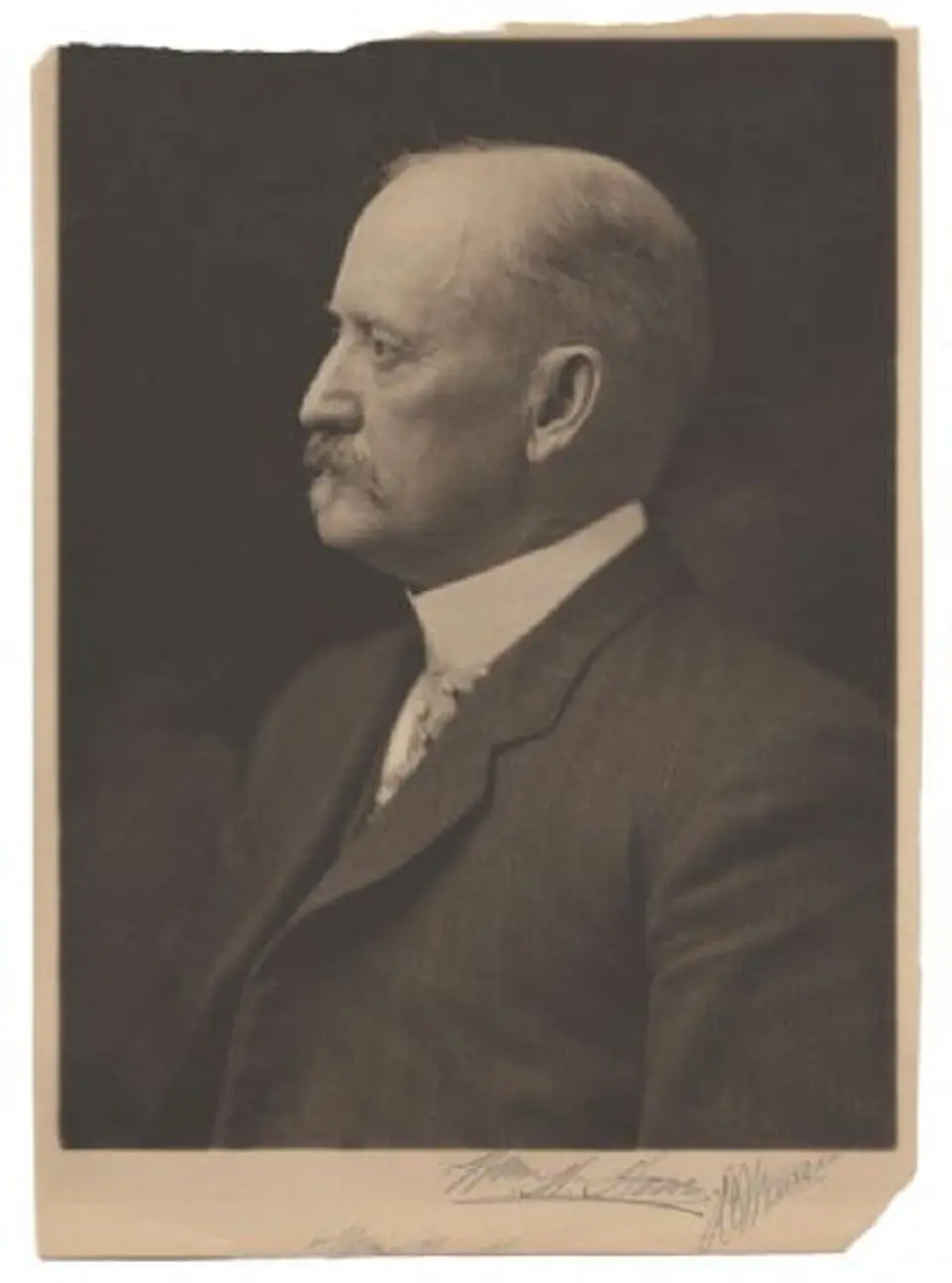
William H. Howe
During his youth, Howe engaged in mercantile activities in Grand Rapids, Michigan, and later in Saint Louis, where he also studied elementary drawing. Soon after (in 1880), he went abroad to continue his studies, first for two years at the Royal Academy in Düsseldorf and then in Paris under Felix de Vuillefroy and Otto de Thoren, an Austrian painter of cattle. During these twelve years in Europe, he made many sketching trips to Normandy and Holland and exhibited at the Paris Salons from 1883 to 1893. Upon his return to America in 1893, he set up a studio in New York City, but soon moved to Bronxville, New York, to help found a small artists' colony there. After 1902 he spent his summers in Old Lyme, Connecticut. Howe won gold medals at the Universal Exposition of 1889 in Paris, the Pennsylvania Academy of the Fine Arts in 1890, and the Crystal Palace Exposition of 1890. He was elected an academician of the National Academy of Design in 1897 and was decorated by the French government with the Cross of the Legion of Honor in 1898.Although an early admirer of both the Dutch painter Émile Van Marcké and the Austrian painter de Thoren, Howe's true source of inspiration seems to have derived from the better known examples of landscapes with cattle by Constant Troyon. For John Van Dyke's anthologyModern French Masters(1896), Howe contributed a lengthy eulogy on the Frenchanimalier.Howe departs from his European prototypes, however, in his predilection for large bovine portraits instead of scenes where animal and land coexist in harmony. Often close to life size, works such as Howe'sMonarch of the Farm[Smithsonian American Art Museum, 1921.1.3] represented a level of late-nineteenth-century taste that very nearly brought the barn stall into the American living room.Peter BerminghamAmerican Art in the Barbizon Mood(Washington, D.C.: National Collection of Fine Arts and Smithsonian Institution Press, 1975)
Art by William H. Howe
View allWilliam H. Howe
William H. Howe: Elevate your space with the lush, beautifully lit late 19th-century American pastoral and bovine landscapes of William H. Howe.