
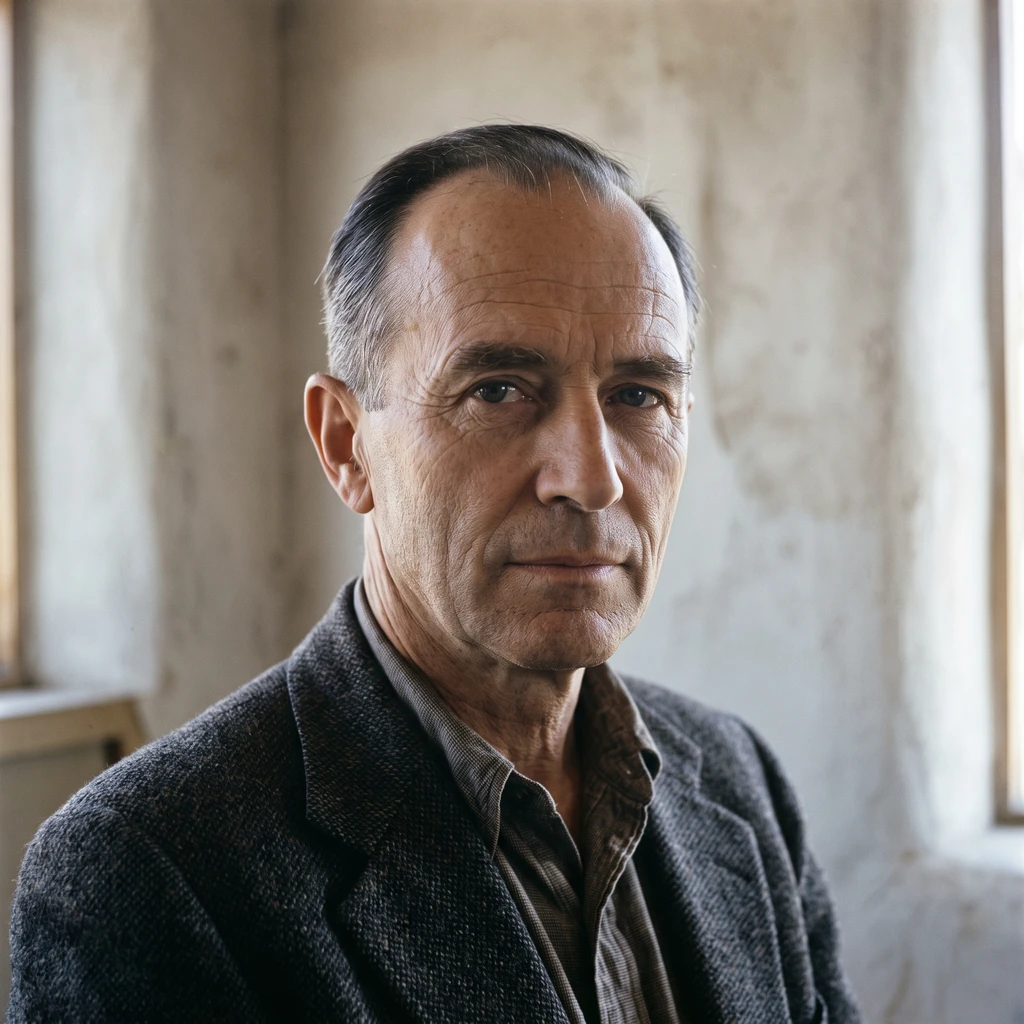
Emil Bisttram
Bisttram, who left his native Hungary as a young boy, began a career as a commercial artist in New York. He then changed direction, studying successively at the National Academy of Design, Cooper Union, the Art Students League, and with Howard Giles at the New York School of Fine and Applied Art. Bisttram developed into an accomplished teacher in his own right during this period. In 1930 he traveled to New Mexico for a three-month stay, finding it difficult to adjust at first to the strong light and color. He then went to Mexico, supported by a Guggenheim grant, to study fresco techniques with Diego Rivera. After returning to Taos (1932), he started the Heptagon Gallery, probably the first commercial gallery in town, and the Taos School of Art, with a decidedly avant-garde curriculum. Bisttram's own style, which reflected the extent of his taste and interest, ranged from a broad, calm 1930s classicism to cosmic abstractions based on Jay Hambidge's Dynamic Symmetry theory. In 1938 Bisttram founded the New Mexico Transcendental Artists group and in 1952 cofounded the Taos Art Association.Charles Eldredge, Julie Schimmel, and William H. TruettnerArt in New Mexico, 1900–1945: Paths to Taos and Santa Fe(Washington, DC: National Museum of American Art, Smithsonian Institution, 1986)
Art by Emil Bisttram
View allEmil Bisttram
Emil Bisttram: Elevate your space with the highly geometric, intensely spiritual 20th-century American Transcendental Painting Group abstract works of Emil Bisttram.