
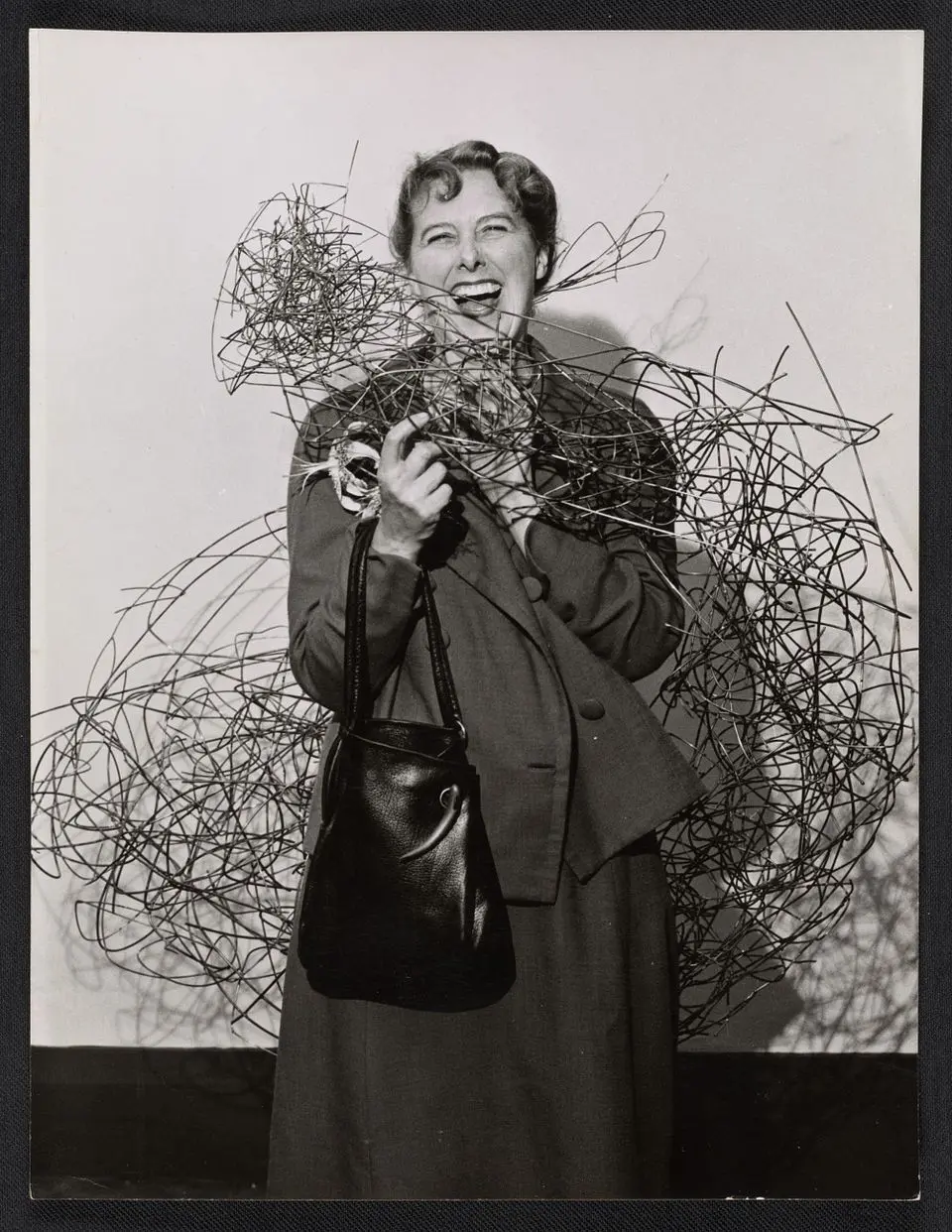
Claire Falkenstein
Claire Falkenstein was an artist driven by a strong commitment to experimentation and a keen attention to natural phenomena. “The only restriction was my own limitations,” she stated, “and I was testing them all the time.”Falkenstein began her artistic career in San Francisco after receiving a BA from the University of California, Berkeley, in 1930. That same year she held her first solo exhibition at the East West Gallery, showing semi-abstract drawings of nude figures. As the decade unfolded, Falkenstein made representational works likeInside a Lumber Mill(1934, SAAM) that developed themes key to many artists during the Great Depression, including rural living and American industriousness. Near the end of the 1930s, Falkenstein began probing the dynamics between interior and exterior space—void and form—in abstract clay sculptures.During the 1940s, Falkenstein was president of the San Francisco Society of Women Artists and taught at the California College of Fine Arts. This innovative artistic context fostered her turn to biomorphic abstractions and experimental printmaking. She also started making wood sculptures, deeming this her “most creative beginning.” With works likeBlack and Red Vertical(1941, SAAM) andFertility(1941, SAAM), Falkenstein arrived at a way “to fuse painting with sculpture.” In her subsequentSet Structuresseries (1941–44), Falkenstein explored dividing masses of wood into pieces that viewers could manipulate, placing “volumes in a state of motion,” as she put it.In 1950, Falkenstein relocated to Paris, where she was championed by influential French critic Michel Tapié. While abroad, she fashioned jewelry and produced large-scale, steel-wire sculptures, often suspended in mid-air likeEnvelope(1958, SAAM). By privileging interior space in these works, Falkenstein pursued what she described as a “movement away from classical attitudes—from the solid to the open, from the centralized to the decentralized, from the contracting to the expanding.” Falkenstein’s experimentation with wire also informed her etchings, such asUntitled III (I, II)(1952, SAAM), which similarly featured webs of line. By 1954, she had discovered how to melt glass into metal, bringing color into her work, like inCorona(1971, SAAM).Around the decade’s end, Falkenstein began working on major architectural commissions. She made woven metal gates accented with local colored glass for Peggy Guggenheim’s villa and eventual museum inVenice(1961). In 1963, Falkenstein moved to Los Angeles, where she created the doors and colored glass windows for St. Basil Church (1968–69) as well as public fountains.During the 1980s, Falkenstein shifted her focus to several series of large paintings. Working with the figure as she had at her career’s beginning, Falkenstein continued explorations of form, space, motion, and color. Yet she was quick to note that this return was not “a full circle,” claiming, “There is never a full circle, everything remains open.”Authored by Katherine Markoski, American Women’s History Initiative Writer and Editor, 2024.
Art by Claire Falkenstein
View allClaire Falkenstein
Claire Falkenstein: Enhance your walls with the spectacular, highly chaotic, mid-20th-century American Abstract Expressionist sculptural works of Claire Falkenstein.